 SynthMaker
Quantiser
It snaps a moving voltage to the nearest note of a scale or a chord, so a random or sliding line plays in key.
1Add it
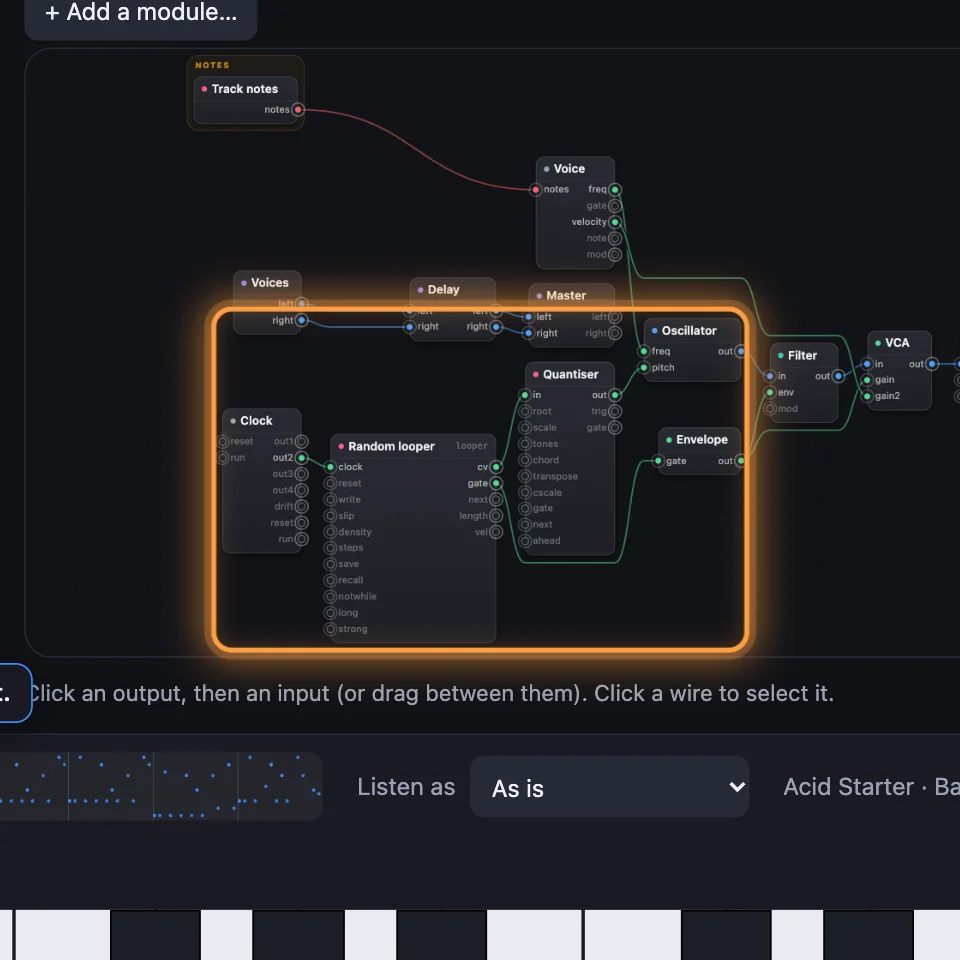
Choose Quantiser under Notes. It plays the pitch of the sound’s oscillators, and its line comes from a Random looper: if the sound has no looper free, one comes with it, and a Clock. The looper’s gate opens the envelope. The Voice switches to Mono, so the Clock plays it when you press ▶ in the transport; hold a key and it plays with the song stopped too. It all comes in as one Undo step.
2From a voltage to a note
Its in takes a voltage from 0 to 1 (0 to 5 V). The Quantiser spreads it over the notes from Low to High, then takes the nearest note it’s allowed: the notes of Scale on Root, or, with Mode at Chord, only the chord’s notes. Its out is that note’s pitch, 1 V an octave, 0 V the C in the middle of the keyboard.
A new note is chosen when the voltage changes. A slow wave into it climbs the scale note by note; a random looper’s steps become a tune. With a gate in its gate input it plays notes instead: it picks one where the gate rises and holds it until the next, so a note keeps its pitch while it rings.
3Its knobs
Root and Scale are the key: Lydian, Major, Mixolydian, Dorian, Minor (as it comes), Harmonic minor, Phrygian, the two pentatonics, Blues and Chromatic.
Mode: Scale, Chord (the chord’s notes only, from a Chord progression’s tones), or Chord scale (the chord’s own scale, its chord tones while the chord input is high). Low and High are the range, in notes (A3 to C5 as it comes).
Avoid leaves out the passing notes a semitone from the chord. Release and Grace are for looking ahead: a note that would ring into a chord it clashes with ends early, so its tail has faded Grace after the change (Release is the voice’s release).
4Its ports
Every input carries a voltage: a wire’s 1.0 is 5 V. Pitches count 1 V an octave.
| In | What it carries |
|---|---|
in | The voltage to snap, 0 to 5 V. |
root, scale | Change the key by voltage. |
tones | A Chord progression’s chord (its tones out). |
chord | A gate: while high, chord notes only. |
transpose | Moves the note by steps of what’s allowed, so a tune moved up stays in key. |
cscale | The chord’s own scale (a Chord progression’s scale out). |
gate | With a gate in, it plays notes: one picked where the gate rises, held until the next. |
next, ahead | The next chord and the seconds until it, from a Chord progression: notes that would clash end early. |
| Out | What it carries |
|---|---|
out | The note’s pitch, 1 V an octave: five wires into an oscillator’s pitch. |
trig | A short trigger whenever the note changes. |
gate | The gate passed on, ended early where a note would clash. |
Try it
- Open the example and press ▶: an Arc’s slow ramp into the Quantiser climbs a pentatonic scale, a note at a time.
- Set Scale to Major, then to Blues: the same ramp, other notes.
- Widen Low and High for a longer run.
Remember
- A voltage in, the nearest allowed note out: a scale on a root, or the chord.
- Added to a sound it plays the oscillators’ pitch, its line from a Random looper.
- Its out is 1 V an octave: five wires into an oscillator’s pitch.