 SynthMaker
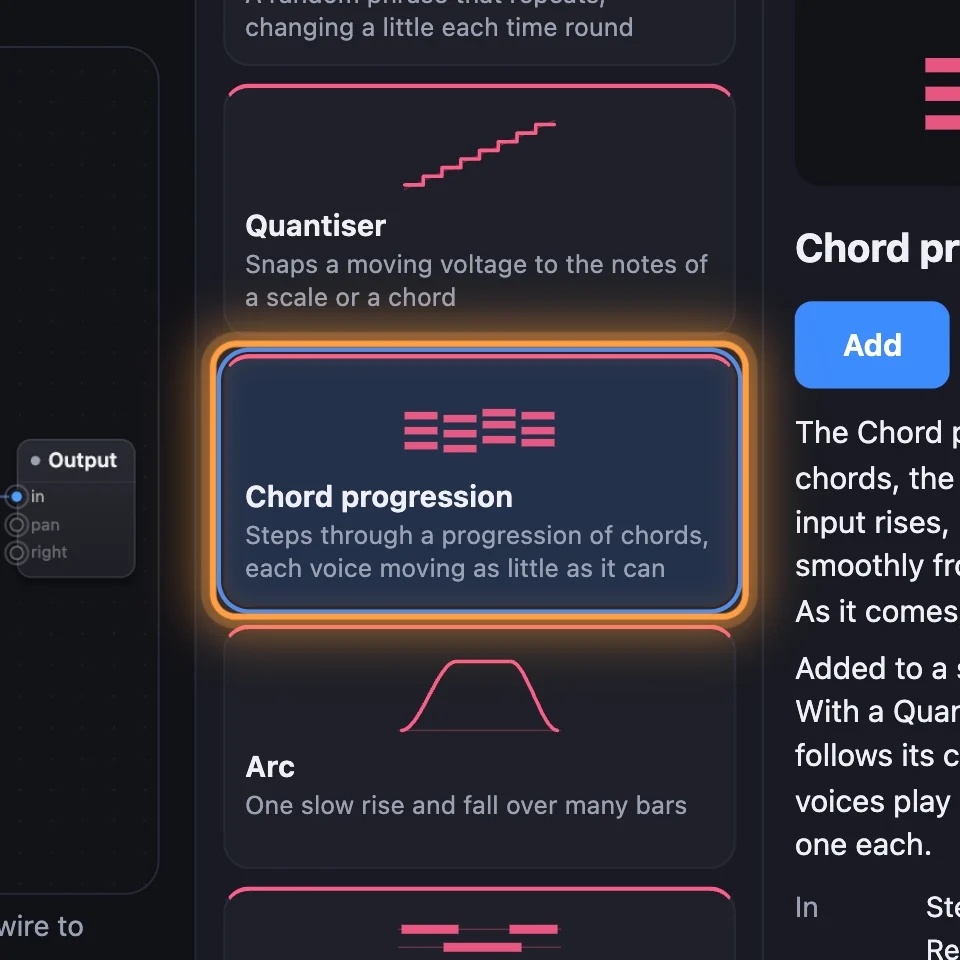
Chord progression
It steps through a list of chords, each voice moving as little as it can to the next. As it comes, a progression in D minor.
1Add it
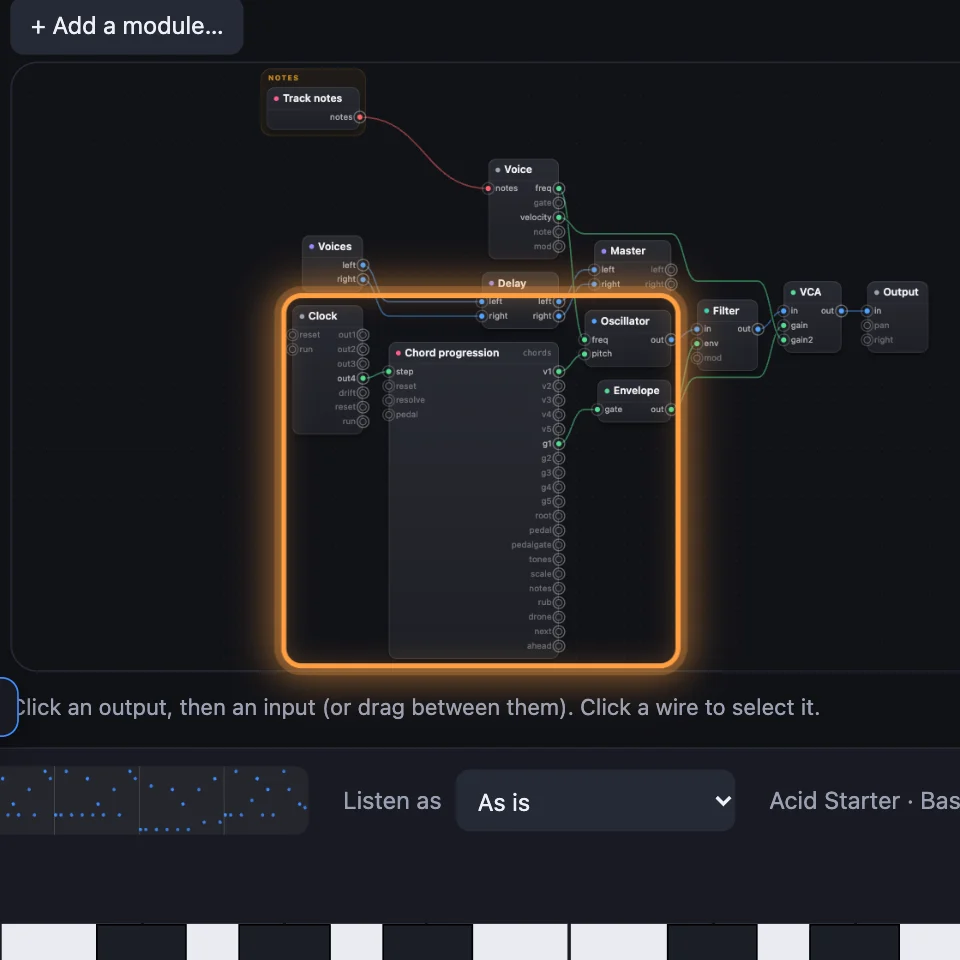
Choose Chord progression under Notes. It steps once a bar, from the sound’s Clock (one comes with it when there isn’t one). If the sound has a Quantiser, it feeds it: the line’s notes follow the chords, and the Quantiser goes to Chord scale, with chord notes on each beat. Without one, its voices play the sound’s oscillators, one each, and its first voice’s gate opens the envelope. The Voice switches to Mono, so the Clock plays it when you press ▶ in the transport; hold a key and it plays with the song stopped too. It all comes in as one Undo step.
2Chords that flow
It holds up to 64 chords. Each rising edge in step plays the next one, and reset goes back to the first. Steps is how many of them it uses (8 as it comes); each has a root, a quality (from triads to 13ths), a bass for a slash chord, a length in steps and a scale, set in its code.
Its voices are led: of all the ways to play the next chord between Low and High, it takes the one where the voices move least, so the chords flow into each other instead of jumping. Its tones and scale outputs tell a Quantiser which notes are in the chord now.
3Its knobs
Key moves the whole progression. Voices is four or five. Style narrows the voicing: Free, Shell (root, third and seventh), Rootless, or Drop 2.
Low and High are the range the voices stay in. Common: a voice whose note stays the same keeps sounding (or every voice starts again). Pedal turns on the drone on the key’s root, and Resolve at is where a suspended chord resolves, through the chord.
Each chord in use, 1 to Steps, has six knobs of its own on the card: its root, its quality (chord), a bass, its length in steps, where it resolves and its scale. The chords past Steps hide their knobs and keep their settings: turn Steps up and they’re back.
4Its ports
Pitches count 1 V an octave (0.2 on a wire); gates are high at 5 V.
| In | What it carries |
|---|---|
step | Each rising edge plays the next chord (the Clock’s bars, as it arrives). |
reset | Back to the first chord. |
resolve | A rising edge resolves a suspended chord now. |
pedal | A gate for the pedal note. |
| Out | What it carries |
|---|---|
v1 … v5 | Each voice’s pitch: five wires into an oscillator’s pitch. |
g1 … g5 | Each voice’s gate, starting again when its note changes. |
root | The bass, from the C two octaves down. |
pedal, pedalgate | The key’s root, and its gate. |
tones, scale | The chord’s notes and its scale, for a Quantiser. |
notes | The same voicing as notes, for another sound in a song. |
rub, drone | How much the chord clashes with the pedal, and 1 − that: the drone’s level. |
next, ahead | The next chord’s safe notes and the seconds until it, for a Quantiser. |
Try it
- Open the example and press ▶: three oscillators play its first three voices, a chord each beat.
- Turn Key: the progression moves.
- Set Style to Shell, then to Drop 2: the same chords, voiced differently.
Remember
- A list of chords, the next on each step, the voices moving as little as they can.
- It feeds a Quantiser’s line, or plays the oscillators one voice each.
- Its tones and scale go to a Quantiser; its notes to another sound in a song.