 SynthMaker
Keys: notes to volts
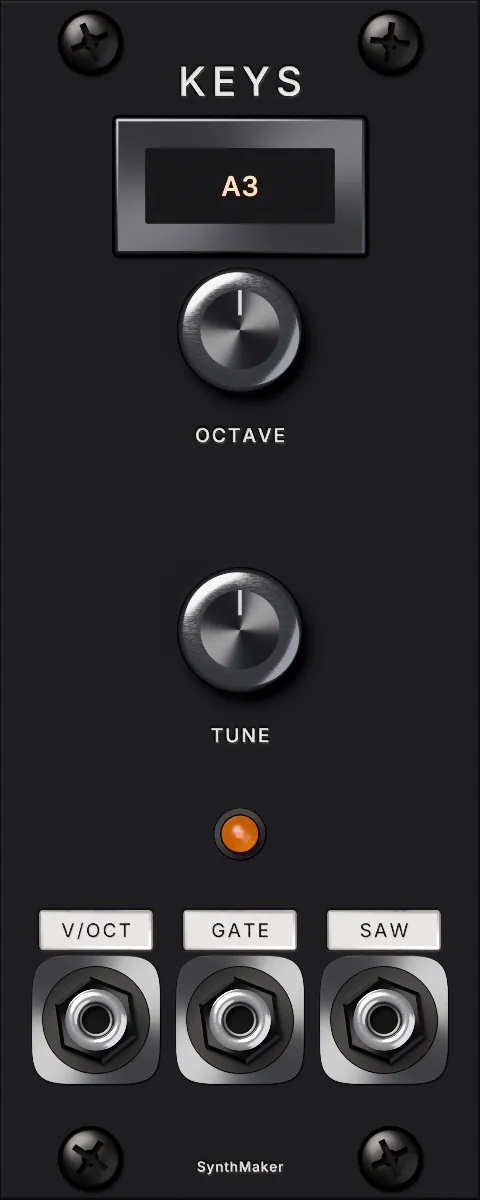
Keys turns what you play into the case's language: a voltage for the pitch, a gate while a key is held, and a plain saw to start from.
- Width
- 8 HP
- Step
- 1 of the case
- Lesson
- 1 · This synth has no oscillator
Filament is being built in the open. This unit's circuit plays here in your browser, and the whole case plays in SynthMaker for Mac.
Listen
Six circuits, one minute
Six sounds from SynthMaker's circuits (the circuits course and Filament's Ladder), rendered offline at full circuit quality: the Ladder sings, chords pour through its ten transistors, an OTA filter bubbles, a diode filter screams, an OTA bass growls, an acid filter squelches, and the Ladder sings again. The drums are SynthMaker's own. 0:58
Play it
2 patches with Keys in them, each played live in your browser by the same circuit solver as the app. Press Play, then turn the knobs; with Live wires on, the schematic and the parts list follow the signal.
Keys play the ladder
Tutorial 1's patch: nothing but Keys' V/OCT into the ladder's V/OCT, its resonance just past where it rings on its own. The filter is the oscillator.
circuit Ladder setting input: 2 V, from 0.2 V to 20 V setting output: 2 V, from 0.2 V to 20 V setting cutoff: 1M, from 8.2M to 82k setting resonance: 30% in cv: from -3 V to 2 V V1 vcc gnd 15V V2 gnd vneg 3V Rb5 vcc b4 7.5k Rb4 b4 b3 1.5k Rb3 b3 b2 1.5k Rb2 b2 b1 1.5k Rb1 b1 gnd 1.5k Rin in bl 47k Nl bl gnd thermal 1k Nr br gnd thermal 1k Rfb fbk br 9.1k P1 out fbk gnd 1k resonance Q1 l1 bl tail 2N3904 Q2 r1 br tail 2N3904 C1 l1 r1 68n Q3 l2 b1 l1 2N3904 Q4 r2 b1 r1 2N3904 C2 l2 r2 68n Q5 l3 b2 l2 2N3904 Q6 r3 b2 r2 2N3904 C3 l3 r3 68n Q7 l4 b3 l3 2N3904 Q8 r4 b3 r3 2N3904 C4 l4 r4 68n Q9 vcc b4 l4 2N3904 Q10 vcc b4 r4 2N3904 U1 l4 bufl bufl opamp U2 r4 bufr bufr opamp R1 bufl m 10k R2 m out 500k R3 bufr p 10k R4 p gnd 500k U3 p m out opamp Rref vcc nref cutoff Q11 nref vneg nexp 2N3904 U4 vneg nref nexp opamp rails 15V Q12 tail ncv nexp 2N3904 Rcv cv ncv 100k Rcg ncv vneg 1.82kend# SynthMaker · Filament Keys · Keys play the laddervoice = Voice(mode: Mono)voct = VOct()trim = VTrim(scale: 1.0125)ladder = Ladder(resonance: 0.88, cutoff: 1.49M, output: 1 V)env = Envelope(attack: 25 ms, decay: 400 ms, sustain: 0.8, release: 350 ms)vca = VCA(level: 0.75)voice.note -> voct -> trim -> ladder.cvladder -> vca -> outvoice.gate -> env -> vca.gainvoice.velocity -> vca.gain2Press Play to see the wave after the circuit, at out.
Keys' saw through the ladder
Keys' own SAW into the ladder's IN, its V/OCT into V/OCT so the filter follows the notes: the plainest subtractive voice.
circuit Ladder setting input: 2 V, from 0.2 V to 20 V setting output: 2 V, from 0.2 V to 20 V setting cutoff: 1M, from 8.2M to 82k setting resonance: 30% in cv: from -3 V to 2 V V1 vcc gnd 15V V2 gnd vneg 3V Rb5 vcc b4 7.5k Rb4 b4 b3 1.5k Rb3 b3 b2 1.5k Rb2 b2 b1 1.5k Rb1 b1 gnd 1.5k Rin in bl 47k Nl bl gnd thermal 1k Nr br gnd thermal 1k Rfb fbk br 9.1k P1 out fbk gnd 1k resonance Q1 l1 bl tail 2N3904 Q2 r1 br tail 2N3904 C1 l1 r1 68n Q3 l2 b1 l1 2N3904 Q4 r2 b1 r1 2N3904 C2 l2 r2 68n Q5 l3 b2 l2 2N3904 Q6 r3 b2 r2 2N3904 C3 l3 r3 68n Q7 l4 b3 l3 2N3904 Q8 r4 b3 r3 2N3904 C4 l4 r4 68n Q9 vcc b4 l4 2N3904 Q10 vcc b4 r4 2N3904 U1 l4 bufl bufl opamp U2 r4 bufr bufr opamp R1 bufl m 10k R2 m out 500k R3 bufr p 10k R4 p gnd 500k U3 p m out opamp Rref vcc nref cutoff Q11 nref vneg nexp 2N3904 U4 vneg nref nexp opamp rails 15V Q12 tail ncv nexp 2N3904 Rcv cv ncv 100k Rcg ncv vneg 1.82kend# SynthMaker · Filament Keys · Keys' saw through the laddervoice = Voice(mode: Mono)saw = Oscillator(wave: Saw)voct = VOct()trim = VTrim(scale: 1.0125)ladder = Ladder(resonance: 0.45, cutoff: 600k, input: 1.5 V, output: 2 V)env = Envelope(attack: 10 ms, decay: 400 ms, sustain: 0.8, release: 300 ms)vca = VCA(level: 0.5)voice -> saw -> ladder -> vca -> outvoice.note -> voct -> trim -> ladder.cvvoice.gate -> env -> vca.gainvoice.velocity -> vca.gain2Press Play to see the wave after the circuit, at out.
The manual
Every note you play becomes two voltages. V/OCT is the pitch, one volt per octave, with middle C at 0 V: play an octave up and it rises by exactly 1 V. GATE is high, 5 V, for as long as the key is held, and drops to 0 V when you let go.
Any unit that takes a V/OCT input follows the keys: the VCO plays the notes, and the ladder's cutoff tracks them, so a singing ladder plays in tune. The GATE is what starts an envelope.
The small screen shows the note being played, and the light blinks at every new note, so you can see legato playing as well as hear it.
Knobs
- OCTAVEShifts the SAW output up or down by whole octaves, three each way.
- TUNEFine-tunes the SAW output, up to a semitone each way.
Jacks
- V/OCToutThe pitch of the note held, 1 V per octave around middle C.
- GATEout5 V while a key is held, 0 V when it's let go.
- SAWoutA ready-made sawtooth at the note's pitch, for patching sound in before there's a VCO.
Inside: the circuit
Keys has no circuit of its own: it is the meeting point between your keyboard and the voltages. Its two small code modules are below: VOct turns the MIDI note into volts, and Blink makes the light flash at each new note.
module VOct in n out y y = (n - 60) / 60endmodule Blink in g out y on note: t = 0 t = t' + 1 / rate y = if t < 0.07 then 0 else gendPictures
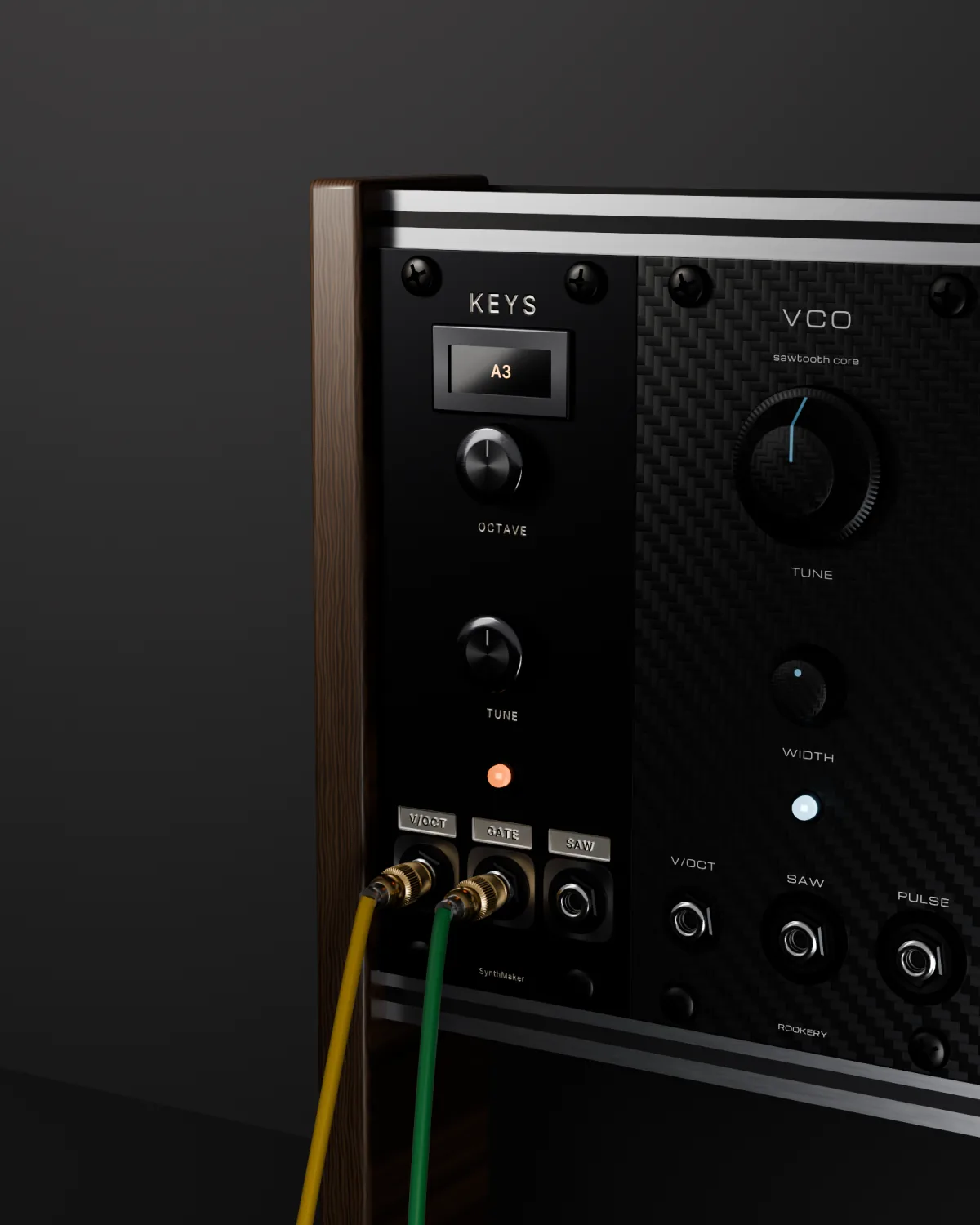
Follow along
Filament 1
This synth has no oscillator
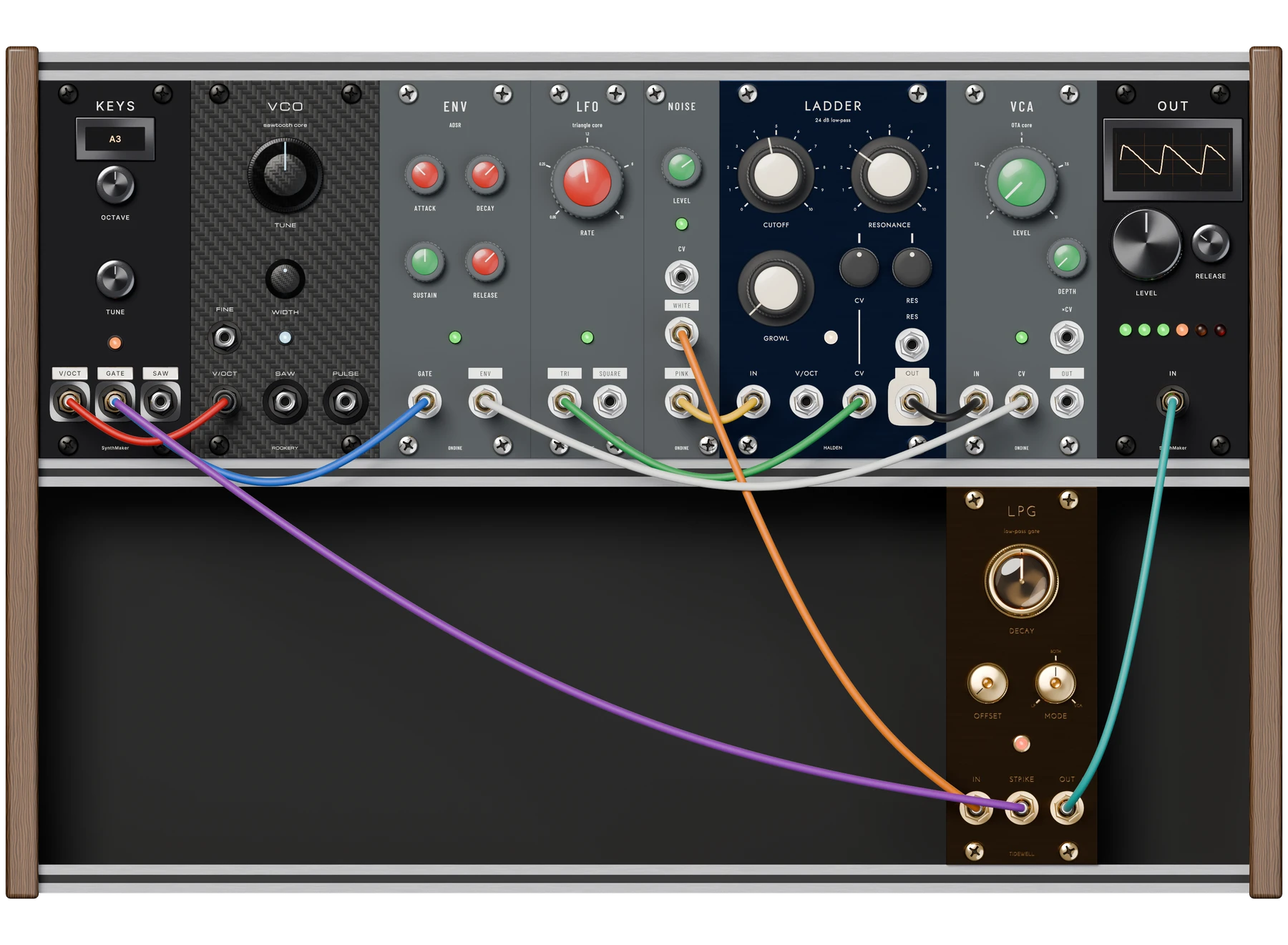
Build Keys, a transistor ladder and Out in an empty case, then turn up the resonance until the filter sings the notes.
This lesson is in SynthMaker for Mac: Help › Lessons › Filament 1.
Build it in SynthMaker for MacFilament's makers are imaginary, except SynthMaker. Every circuit is real.