 SynthMaker
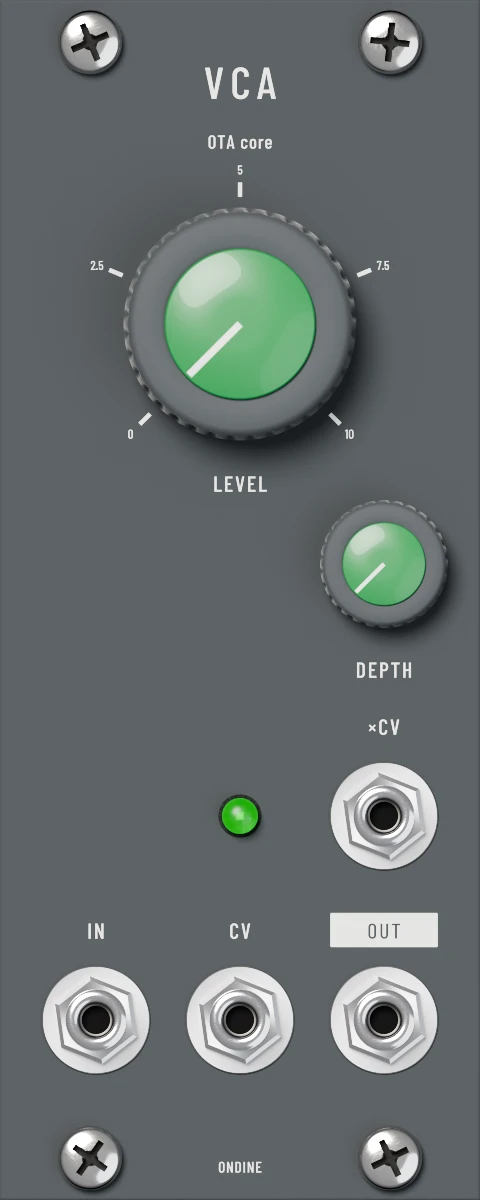
VCA: OTA
A voltage-controlled amplifier around a real OTA: the envelope or the LFO sets how loud, so notes swell, sustain and fade.
- Width
- 8 HP
- Step
- 5 of the case
- Lesson
- 5 · Pads from the same patch
Open it up. Its circuit opens in SynthMaker: change a part, add one, wire it to other modules, or make it a module of your own with its own face.
Open its circuit in SynthMaker (opens in a new tab)Looking inside is free. Changing it is part of SynthMaker Pro.Filament is being built in the open. This unit's circuit plays here in your browser, and the whole case plays in SynthMaker for Mac.
What it could be · 1 of 2
Tremolo glass
Rendered offline at full circuit quality. The hats are the noise unit through the VCA. 0:43
What it could be · 2 of 2
Pluck sequence
Rendered offline at full circuit quality. The kick is the Ladder too, pinged by a short pulse; the hats and snare are the noise unit through the VCA. 0:44
Play it
3 patches with VCA in them, each played live in your browser by the same circuit solver as the app. Press Play, then turn the knobs; with Live wires on, the schematic and the parts list follow the signal.
Pads
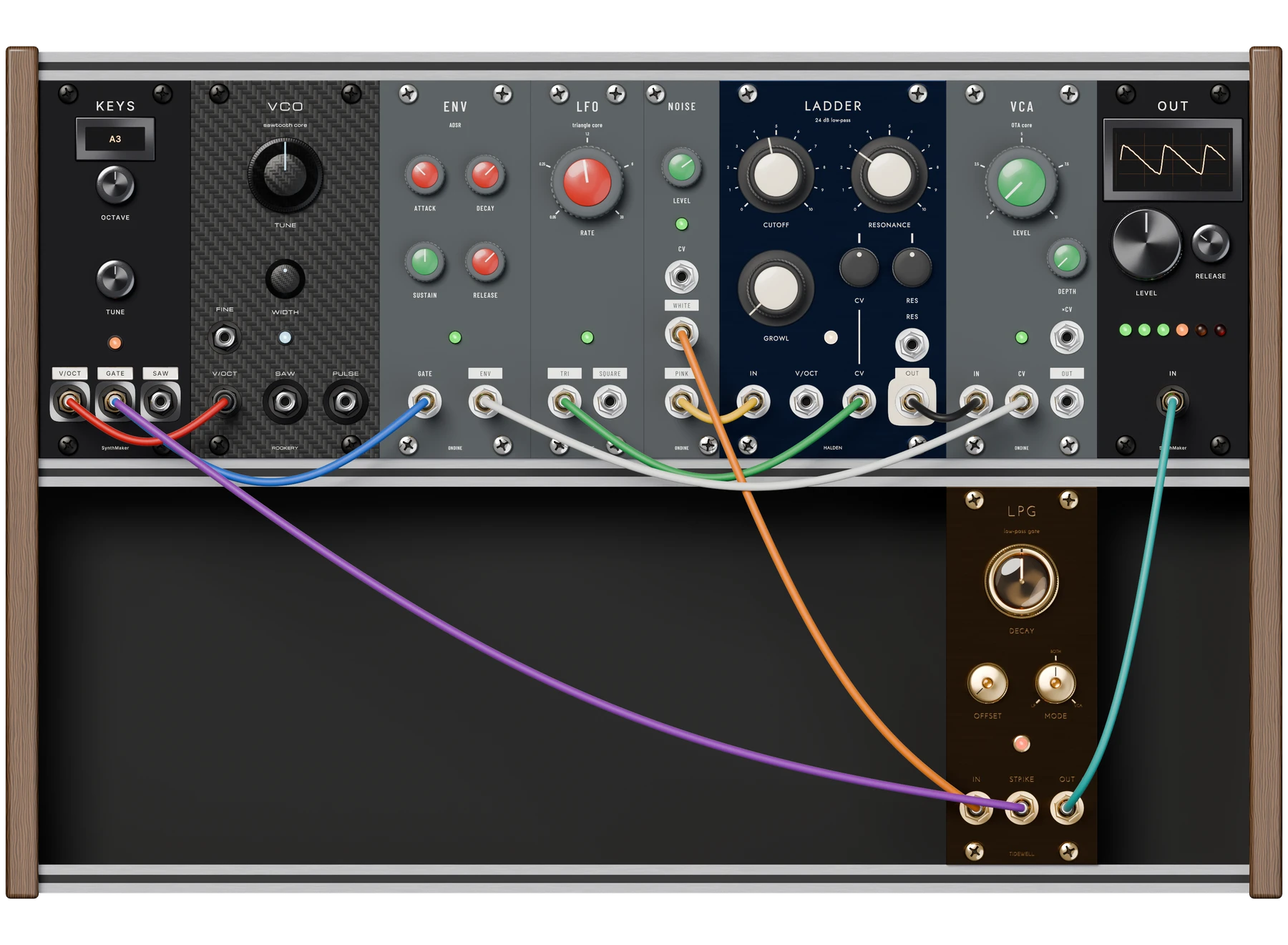
Tutorial 5's pads: the envelope into the VCA's CV with a slow attack, full sustain and a long release. Held notes swell, stay and fade.
circuit OTAVCA setting level: 0% setting input: 5 V setting output: 5 V oversample 1x in cv: from 0 V to 10 V V1 v10 gnd 10V P1 v10 lv gnd 10k level R3 cv s 100k R4 lv s 100k U2 s fb gain opamp rails -1V 10V Rf fb gain 10k Rg fb gnd 10k Rb gain abc 47k R1 in p 100k R2 p gnd 220 R5 m gnd 220 A1 p m o abc ota RL o gnd 47k U1 o fb2 out opamp Rf2 out fb2 15k Rg2 fb2 gnd 10kend# SynthMaker · Filament VCA · Padsvoice = Voice(mode: Mono)voct = VOct()trim = VTrim(scale: 1.0125)vco = VCO()ladder = Ladder(resonance: 0.4, cutoff: 1.8M, output: 1 V)adsr = ADSR(attack: 680k, decay: 470k, sustain: 95%, release: 680k)ota = OTAVCA(level: 0%)env = Envelope(attack: 5 ms, decay: 400 ms, sustain: 1, release: 1500 ms)vca = VCA(level: 0.6)voice.note -> voct -> vco.voctvoct -> trim -> ladder.cvvco -> ladder -> ota -> vca -> outvoice.gate -> adsr.gateadsr -> ota.cvvoice.gate -> env -> vca.gainvoice.velocity -> vca.gain2Press Play to see the wave after the circuit, at out.
On the web: The web engine plays one way out per circuit for now (the app's several outputs per circuit aren't on the web yet), and every web circuit has an in: here SAW is the circuit's out, PULSE's parts are left out, and in rests on 1 MΩ to ground.
On the web: Every web circuit has an in (the app's envelope needs none): here it rests on 1 MΩ to ground, joined to nothing else.
On the web: The web engine plays one way out per circuit for now (the app's several outputs per circuit aren't on the web yet): here OUT is the circuit's out and GAIN, the light's, stays inside.
Plucks
The same patch, the envelope short: no attack, a quick decay and no sustain, and the VCA plucks every note. Turn LEVEL up to hold it open under the plucks.
circuit OTAVCA setting level: 0% setting input: 5 V setting output: 5 V oversample 1x in cv: from 0 V to 10 V V1 v10 gnd 10V P1 v10 lv gnd 10k level R3 cv s 100k R4 lv s 100k U2 s fb gain opamp rails -1V 10V Rf fb gain 10k Rg fb gnd 10k Rb gain abc 47k R1 in p 100k R2 p gnd 220 R5 m gnd 220 A1 p m o abc ota RL o gnd 47k U1 o fb2 out opamp Rf2 out fb2 15k Rg2 fb2 gnd 10kend# SynthMaker · Filament VCA · Plucksvoice = Voice(mode: Mono)voct = VOct()trim = VTrim(scale: 1.0125)vco = VCO()ladder = Ladder(resonance: 0.5, cutoff: 1.5M, output: 1 V)adsr = ADSR(attack: 1k, decay: 150k, sustain: 0%, release: 100k)ota = OTAVCA(level: 0%)env = Envelope(attack: 2 ms, decay: 400 ms, sustain: 1, release: 300 ms)vca = VCA(level: 0.6)voice.note -> voct -> vco.voctvoct -> trim -> ladder.cvvco -> ladder -> ota -> vca -> outvoice.gate -> adsr.gateadsr -> ota.cvvoice.gate -> env -> vca.gainvoice.velocity -> vca.gain2Press Play to see the wave after the circuit, at out.
On the web: The web engine plays one way out per circuit for now (the app's several outputs per circuit aren't on the web yet), and every web circuit has an in: here SAW is the circuit's out, PULSE's parts are left out, and in rests on 1 MΩ to ground.
On the web: Every web circuit has an in (the app's envelope needs none): here it rests on 1 MΩ to ground, joined to nothing else.
On the web: The web engine plays one way out per circuit for now (the app's several outputs per circuit aren't on the web yet): here OUT is the circuit's out and GAIN, the light's, stays inside.
Tremolo
The LFO's TRI in the VCA's CV and LEVEL half up: the volume rises and falls around the middle, five times a second. Turn LEVEL to set where it swings, RATE how fast.
circuit OTAVCA setting level: 0% setting input: 5 V setting output: 5 V oversample 1x in cv: from 0 V to 10 V V1 v10 gnd 10V P1 v10 lv gnd 10k level R3 cv s 100k R4 lv s 100k U2 s fb gain opamp rails -1V 10V Rf fb gain 10k Rg fb gnd 10k Rb gain abc 47k R1 in p 100k R2 p gnd 220 R5 m gnd 220 A1 p m o abc ota RL o gnd 47k U1 o fb2 out opamp Rf2 out fb2 15k Rg2 fb2 gnd 10kend# SynthMaker · Filament VCA · Tremolovoice = Voice(mode: Mono)voct = VOct()trim = VTrim(scale: 1.0125)vco = VCO()ladder = Ladder(resonance: 0.3, cutoff: 1.5M, output: 1 V)lfo = TriangleCore(rate: 50k)ota = OTAVCA(level: 55%)env = Envelope(attack: 20 ms, decay: 400 ms, sustain: 1, release: 500 ms)vca = VCA(level: 0.7)voice.note -> voct -> vco.voctvoct -> trim -> ladder.cvvco -> ladder -> ota -> vca -> outlfo -> ota.cvvoice.gate -> env -> vca.gainvoice.velocity -> vca.gain2Press Play to see the wave after the circuit, at out.
On the web: The web engine plays one way out per circuit for now (the app's several outputs per circuit aren't on the web yet), and every web circuit has an in: here SAW is the circuit's out, PULSE's parts are left out, and in rests on 1 MΩ to ground.
On the web: The web engine plays one way out per circuit for now (the app's several outputs per circuit aren't on the web yet): here TRI is the circuit's out and SQUARE stays inside.
On the web: The web engine plays one way out per circuit for now (the app's several outputs per circuit aren't on the web yet): here OUT is the circuit's out and GAIN, the light's, stays inside.
The manual
IN goes out at OUT as loud as CV and LEVEL say: nothing in CV and LEVEL at 0 is silence, 10 V is the sound at its own level. The light shows the gain.
With the envelope in CV, a slow attack and full sustain turn the same patch into pads; a short decay and no sustain make it pluck. With the LFO in CV and LEVEL half up, it's tremolo.
×CV multiplies the level instead of adding to it: 0 V is silence and 5 V is the sound as CV and LEVEL leave it, never louder. DEPTH says how much it counts, from not at all (where it starts) to fully, so the envelope can stay in CV while a slow wave in ×CV rides the level.
Knobs
- LEVELA steady opening, 0 to 10 V, added to CV: up full, the VCA stays open whatever CV says.
- DEPTHHow much ×CV counts: at 0 not at all; at full, ×CV alone sets the level.
Jacks
- ×CVinMultiplies the level, 0 to 5 V, as far as DEPTH lets it.
- INinThe sound to shape.
- CVinHow far open, 0 to 10 V (the envelope's range).
- OUToutThe sound, as loud as CV, LEVEL and ×CV let it be.
Inside: the circuit
An operational transconductance amplifier (A1) does the work: the current into its bias pin sets its gain. An op-amp (U2) adds CV and LEVEL, its rails stopping the sum at 10 V, and drives the bias pin through 47k. The sound comes in through 100k over 220 Ω, small enough for the OTA to stay clean, and leaves through RL and a ×2.5 op-amp stage (U1), so at 10 V OUT matches IN. ×CV is a second OTA after it (A2), its bias current set by a Howland current pump (U3 and four matched 47k resistors) so the level follows ×CV in a straight line from 0 V, with U4 holding ×CV between −1 V and 5 V; DEPTH's pot picks between the sound before it and after it.
circuit OTAVCA setting level: 0% setting input: 5 V setting output: 5 V oversample 1x in cv: from 0 V to 10 V out gain V1 v10 gnd 10V P1 v10 lv gnd 10k level R3 cv s 100k R4 lv s 100k U2 s fb gain opamp rails -1V 10V Rf fb gain 10k Rg fb gnd 10k Rb gain abc 47k R1 in p 100k R2 p gnd 220 R5 m gnd 220 A1 p m o abc ota RL o gnd 47k U1 o fb2 out opamp Rf2 out fb2 15k Rg2 fb2 gnd 10kend| Op-amps and comparators 2 | op-amp ×2 U2, U1 |
|---|---|
| Resistors 11 | 100k ×3 R3, R4, R110k ×3 Rf, Rg, Rg247k ×2 Rb, RL220 ×2 R2, R515k Rf2 |
| Pots 1 | 10k (level) P1 |
| Supplies 1 | 10V V1 |
circuit TimesCV setting depth: 0% setting input: 5 V setting output: 5 V oversample 1x in cv U4 cv cl cl opamp rails -1V 5V Rh1 cl abc 47k Rh2 ho abc 47k Rh3 hn gnd 47k Rh4 ho hn 47k U3 abc hn ho opamp rails 15V R1 in p 100k R2 p gnd 22 R5 m gnd 22 A2 p m o abc ota RL o gnd 1M U1 o fb wet opamp Rf wet fb 12.11k Rg fb gnd 10k P1 wet x in 10k depth U2 x out out opampend| Op-amps and comparators 4 | op-amp ×4 U4, U3, U1, U2 |
|---|---|
| Resistors 10 | 47k ×4 Rh1, Rh2, Rh3, Rh4100k R122 ×2 R2, R51M RL12.11k Rf10k Rg |
| Pots 1 | 10k (depth) P1 |
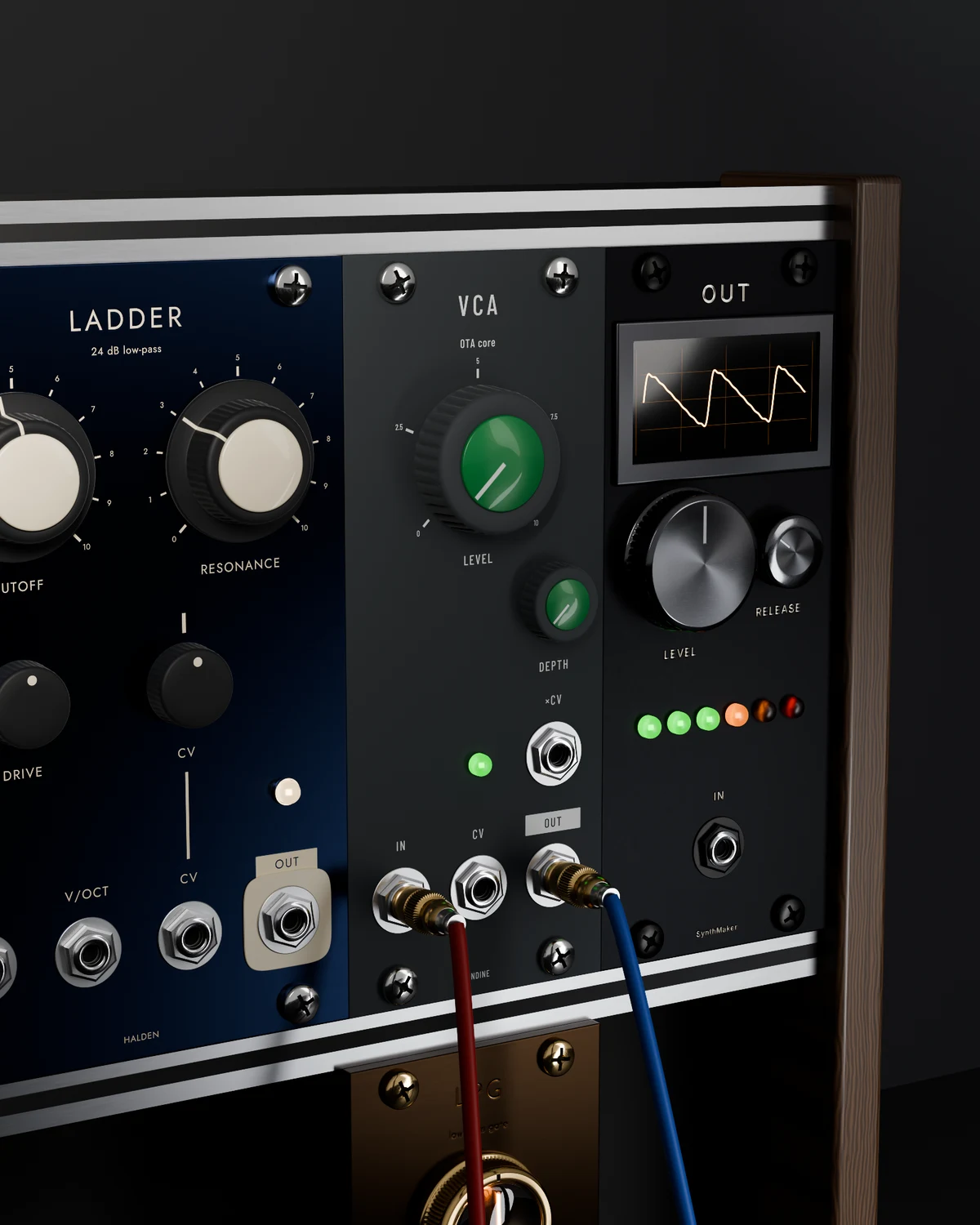
Pictures
Follow along
Filament 5
Pads from the same patch
Put Ondine Labs' VCA between the ladder and Out, patch the envelope into its CV, and the same patch plays swelling pads, then plucks again.
This lesson is in SynthMaker for Mac: Help › Lessons › Filament 5.
Build it in SynthMaker for MacFilament's makers are imaginary, except SynthMaker. Every circuit is real.