 SynthMaker
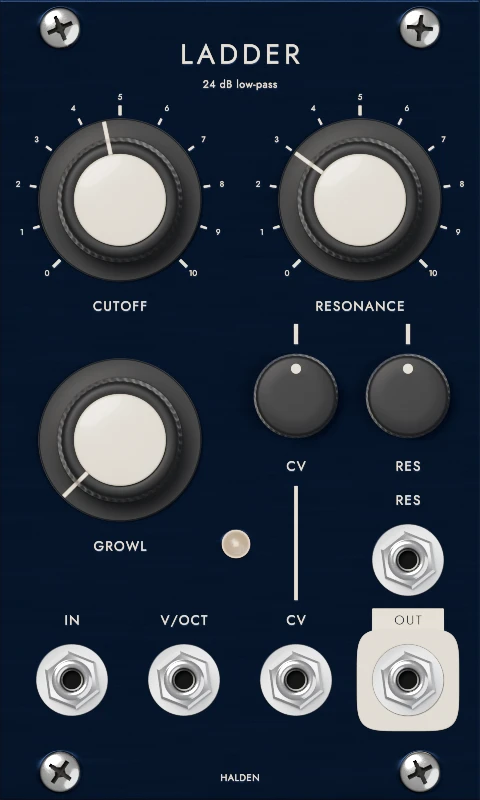
Ladder: 24 dB low-pass
A four-pole transistor ladder: ten transistors stacked like rungs, warm when it's open, squelchy when it moves, and able to sing a note on its own.
- Width
- 12 HP
- Step
- 1 of the case
- Lesson
- 1 · This synth has no oscillator
Open it up. Its circuit opens in SynthMaker: change a part, add one, wire it to other modules, or make it a module of your own with its own face.
Open its circuit in SynthMaker (opens in a new tab)Looking inside is free. Changing it is part of SynthMaker Pro.Filament is being built in the open. This unit's circuit plays here in your browser, and the whole case plays in SynthMaker for Mac.
What it could be · 1 of 2
Resonance sings
Rendered offline at full circuit quality. The hats and snare are the course's noise circuits. 0:45
What it could be · 2 of 2
Acid bloom
Rendered offline at full circuit quality. The kick is the Ladder too, pinged by a short pulse; the hats and snare are the course's noise circuits. 0:45
Play it
3 patches with Ladder in them, each played live in your browser by the same circuit solver as the app. Press Play, then turn the knobs; with Live wires on, the schematic and the parts list follow the signal.
Sung resonance
No oscillator: Keys' V/OCT moves the cutoff, and the resonance, just past where the ladder rings on its own, sings each note. Turn RESONANCE down below about 83% and it falls silent; turn GROWL up and it screams.
circuit Ladder setting input: 2 V, from 0.2 V to 20 V setting output: 2 V, from 0.2 V to 20 V setting cutoff: 1M, from 8.2M to 82k setting resonance: 30% in cv: from -3 V to 2 V V1 vcc gnd 15V V2 gnd vneg 3V Rb5 vcc b4 7.5k Rb4 b4 b3 1.5k Rb3 b3 b2 1.5k Rb2 b2 b1 1.5k Rb1 b1 gnd 1.5k Rin in bl 47k Nl bl gnd thermal 1k Nr br gnd thermal 1k Rfb fbk br 9.1k P1 out fbk gnd 1k resonance Q1 l1 bl tail 2N3904 Q2 r1 br tail 2N3904 C1 l1 r1 68n Q3 l2 b1 l1 2N3904 Q4 r2 b1 r1 2N3904 C2 l2 r2 68n Q5 l3 b2 l2 2N3904 Q6 r3 b2 r2 2N3904 C3 l3 r3 68n Q7 l4 b3 l3 2N3904 Q8 r4 b3 r3 2N3904 C4 l4 r4 68n Q9 vcc b4 l4 2N3904 Q10 vcc b4 r4 2N3904 U1 l4 bufl bufl opamp U2 r4 bufr bufr opamp R1 bufl m 10k R2 m out 500k R3 bufr p 10k R4 p gnd 500k U3 p m out opamp Rref vcc nref cutoff Q11 nref vneg nexp 2N3904 U4 vneg nref nexp opamp rails 15V Q12 tail ncv nexp 2N3904 Rcv cv ncv 100k Rcg ncv vneg 1.82kend# SynthMaker · Filament Ladder · Sung resonancevoice = Voice(mode: Mono)voct = VOct()trim = VTrim(scale: 1.0125)ladder = Ladder(resonance: 0.88, cutoff: 1.49M, output: 2 V)growl = Growl(drive: 0%, output: 0.5 V)env = Envelope(attack: 25 ms, decay: 400 ms, sustain: 0.8, release: 350 ms)vca = VCA(level: 0.75)voice.note -> voct -> trim -> ladder.cvladder -> growl -> vca -> outvoice.gate -> env -> vca.gainvoice.velocity -> vca.gain2Press Play to see the wave after the circuit, at out.
Squelchy bass
A saw low down, GROWL a third of the way up, and a quick envelope into the CV jack opening the filter on every note. Turn RESONANCE up for more squelch, CUTOFF down for a darker bass.
circuit Ladder setting input: 2 V, from 0.2 V to 20 V setting output: 2 V, from 0.2 V to 20 V setting cutoff: 1M, from 8.2M to 82k setting resonance: 30% in cv: from -3 V to 2 V V1 vcc gnd 15V V2 gnd vneg 3V Rb5 vcc b4 7.5k Rb4 b4 b3 1.5k Rb3 b3 b2 1.5k Rb2 b2 b1 1.5k Rb1 b1 gnd 1.5k Rin in bl 47k Nl bl gnd thermal 1k Nr br gnd thermal 1k Rfb fbk br 9.1k P1 out fbk gnd 1k resonance Q1 l1 bl tail 2N3904 Q2 r1 br tail 2N3904 C1 l1 r1 68n Q3 l2 b1 l1 2N3904 Q4 r2 b1 r1 2N3904 C2 l2 r2 68n Q5 l3 b2 l2 2N3904 Q6 r3 b2 r2 2N3904 C3 l3 r3 68n Q7 l4 b3 l3 2N3904 Q8 r4 b3 r3 2N3904 C4 l4 r4 68n Q9 vcc b4 l4 2N3904 Q10 vcc b4 r4 2N3904 U1 l4 bufl bufl opamp U2 r4 bufr bufr opamp R1 bufl m 10k R2 m out 500k R3 bufr p 10k R4 p gnd 500k U3 p m out opamp Rref vcc nref cutoff Q11 nref vneg nexp 2N3904 U4 vneg nref nexp opamp rails 15V Q12 tail ncv nexp 2N3904 Rcv cv ncv 100k Rcg ncv vneg 1.82kend# SynthMaker · Filament Ladder · Squelchy bassvoice = Voice(mode: Mono)saw = Oscillator(wave: Saw)voct = VOct()trim = VTrim(scale: 1.0125)fenv = Envelope(attack: 1 ms, decay: 180 ms, sustain: 0, release: 80 ms)atten = Attenuverter(amount: 85%)ladder = Ladder(resonance: 0.68, cutoff: 3.3M, input: 5 V, output: 2 V)growl = Growl(drive: 33%, output: 1.25 V)env = Envelope(attack: 2 ms, decay: 300 ms, sustain: 0.7, release: 90 ms)vca = VCA(level: 0.55)voice -> saw -> ladder -> growl -> vca -> outvoice.note -> voct -> trim -> ladder.cvvoice.gate -> fenv -> atten -> ladder.cvvoice.gate -> env -> vca.gainvoice.velocity -> vca.gain2Press Play to see the wave after the circuit, at out.
Slow sweep
A slow LFO into the CV jack sweeps the cutoff up and down under long saw notes, the resonance peak whistling as it passes the harmonics.
circuit Ladder setting input: 2 V, from 0.2 V to 20 V setting output: 2 V, from 0.2 V to 20 V setting cutoff: 1M, from 8.2M to 82k setting resonance: 30% in cv: from -3 V to 2 V V1 vcc gnd 15V V2 gnd vneg 3V Rb5 vcc b4 7.5k Rb4 b4 b3 1.5k Rb3 b3 b2 1.5k Rb2 b2 b1 1.5k Rb1 b1 gnd 1.5k Rin in bl 47k Nl bl gnd thermal 1k Nr br gnd thermal 1k Rfb fbk br 9.1k P1 out fbk gnd 1k resonance Q1 l1 bl tail 2N3904 Q2 r1 br tail 2N3904 C1 l1 r1 68n Q3 l2 b1 l1 2N3904 Q4 r2 b1 r1 2N3904 C2 l2 r2 68n Q5 l3 b2 l2 2N3904 Q6 r3 b2 r2 2N3904 C3 l3 r3 68n Q7 l4 b3 l3 2N3904 Q8 r4 b3 r3 2N3904 C4 l4 r4 68n Q9 vcc b4 l4 2N3904 Q10 vcc b4 r4 2N3904 U1 l4 bufl bufl opamp U2 r4 bufr bufr opamp R1 bufl m 10k R2 m out 500k R3 bufr p 10k R4 p gnd 500k U3 p m out opamp Rref vcc nref cutoff Q11 nref vneg nexp 2N3904 U4 vneg nref nexp opamp rails 15V Q12 tail ncv nexp 2N3904 Rcv cv ncv 100k Rcg ncv vneg 1.82kend# SynthMaker · Filament Ladder · Slow sweepvoice = Voice(mode: Mono)saw = Oscillator(wave: Saw)lfo = LFO(shape: Triangle, rate: 0.18 Hz, retrigger: Free)atten = Attenuverter(amount: 95%)ladder = Ladder(resonance: 0.72, cutoff: 1.8M, input: 1.5 V, output: 2 V)growl = Growl(drive: 0%, output: 1 V)env = Envelope(attack: 40 ms, decay: 400 ms, sustain: 0.9, release: 500 ms)vca = VCA(level: 0.5)voice -> saw -> ladder -> growl -> vca -> outlfo -> atten -> ladder.cvvoice.gate -> env -> vca.gainPress Play to see the wave after the circuit, at out.
The manual
A low-pass filter lets the low part of a sound through and takes the top away, 24 dB for every octave above the cutoff. Turn CUTOFF down and a bright saw goes dark; turn it up and it opens again.
RESONANCE feeds the output back into the input. Low, it adds a gentle peak at the cutoff; higher, the peak rings; past about 83% the filter rings on its own and becomes an oscillator. With Keys' V/OCT in its V/OCT jack, it sings the notes you play: Filament's first lesson has no oscillator at all.
GROWL comes after the filter: clean at 0, then gritty, then a scream at full, as two diodes clip the wave harder the further it turns, while the level stays within about 3 dB. The CV knob is an attenuverter: at 12 o'clock it does nothing, clockwise the CV jack opens the filter, anticlockwise it closes it.
RES and its jack do the same for the resonance: centre is off, and either way the jack turns RESONANCE from where it's set. A slow wave there makes the filter swell into singing and fall back, and the cutoff moves with it so the singing stays in tune.
Knobs
- CUTOFFThe corner frequency, about 20 Hz to 20 kHz. It moves the reference resistor of the exponential converter that feeds the ladder's tail current.
- RESONANCEHow much of the output goes back to the input, from none to self-oscillation.
- GROWLHow hard the wave is clipped after the filter, from clean to a scream, the level held within about 3 dB.
- CVHow much the CV jack moves the cutoff, either way: centre is off, clockwise opens, anticlockwise closes.
- RESHow much the RES jack turns RESONANCE, either way: centre is off.
Jacks
- RESinTurns RESONANCE, scaled and turned over by the RES knob: 5 V at full turns it half its travel.
- INinAudio in.
- V/OCTinThe cutoff follows the pitch, 1 V per octave, so the filter tracks the keys (and sings in tune).
- CVinMoves the cutoff, scaled and turned over by the CV knob: an envelope here makes the squelch.
- OUToutThe filtered sound, through GROWL.
Inside: the circuit
Ten transistors are stacked like rungs: four pairs, from the input pair (Q1, Q2) up to Q8, each with a 68 nF capacitor between its collectors, are the filter's four poles, and a fifth pair (Q9, Q10) tops the ladder. The tail current through Q12 sets how fast every rung responds, so it sets the cutoff; Q11 and U4 make that current exponential in the control voltage, which is why a volt more is an octave up. U1 to U3 take the difference between the two sides as the output, and the RESONANCE pot sends part of it back to the input pair. A small attenuverter circuit beside it (an op-amp inverter and a pot) scales the CV jack, and a second one scales the RES jack into the RESONANCE pot, with a small code module (ResTrack) nudging the cutoff as it turns, because the ladder sings flatter as the resonance rises. GROWL is its own small circuit after the output: one gang of a two-gang pot turns up the gain into two silicon diodes (U1) and the other turns it down again after them (U2), so below where the diodes conduct the two cancel, and above it the wave is clipped at their 0.6 V; U3 turns it the right way up.
circuit Ladder setting input: 2 V, from 0.2 V to 20 V setting output: 2 V, from 0.2 V to 20 V setting cutoff: 1M, from 8.2M to 82k setting resonance: 30% in cv: from -3 V to 2 V V1 vcc gnd 15V V2 gnd vneg 3V Rb5 vcc b4 7.5k Rb4 b4 b3 1.5k Rb3 b3 b2 1.5k Rb2 b2 b1 1.5k Rb1 b1 gnd 1.5k Rin in bl 47k Nl bl gnd thermal 1k Nr br gnd thermal 1k Rfb fbk br 9.1k P1 out fbk gnd 1k resonance Q1 l1 bl tail 2N3904 Q2 r1 br tail 2N3904 C1 l1 r1 68n Q3 l2 b1 l1 2N3904 Q4 r2 b1 r1 2N3904 C2 l2 r2 68n Q5 l3 b2 l2 2N3904 Q6 r3 b2 r2 2N3904 C3 l3 r3 68n Q7 l4 b3 l3 2N3904 Q8 r4 b3 r3 2N3904 C4 l4 r4 68n Q9 vcc b4 l4 2N3904 Q10 vcc b4 r4 2N3904 U1 l4 bufl bufl opamp U2 r4 bufr bufr opamp R1 bufl m 10k R2 m out 500k R3 bufr p 10k R4 p gnd 500k U3 p m out opamp Rref vcc nref cutoff Q11 nref vneg nexp 2N3904 U4 vneg nref nexp opamp rails 15V Q12 tail ncv nexp 2N3904 Rcv cv ncv 100k Rcg ncv vneg 1.82kend| Transistors 12 | 2N3904 ×12 Q1, Q2, Q3, Q4, Q5, Q6, Q7, Q8, Q9, Q10, Q11, Q12 |
|---|---|
| Op-amps and comparators 4 | op-amp ×4 U1, U2, U3, U4 |
| Capacitors 4 | 68n ×4 C1, C2, C3, C4 |
| Resistors 14 | 7.5k Rb51.5k ×4 Rb4, Rb3, Rb2, Rb147k Rin9.1k Rfb10k ×2 R1, R3500k ×2 R2, R4set by CUTOFF Rref100k Rcv1.82k Rcg |
| Pots 1 | 1k (resonance) P1 |
| Supplies 2 | 15V V13V V2 |
circuit Attenuverter oversample 1x setting amount: 50% R1 in n 100k R2 n inv 100k U1 gnd n inv opamp P1 in out inv 10k amountend| Op-amps and comparators 1 | op-amp U1 |
|---|---|
| Resistors 2 | 100k ×2 R1, R2 |
| Pots 1 | 10k (amount) P1 |
circuit Growl setting drive: 0% setting output: 1 V, from 0.25 V to 4 V R1 in m1 20k U1 gnd m1 a opamp Rf1 m1 f1 1k P1 f1 f1 a 1M drive audio Rs a c 1k D1 c gnd 1N4148 D2 gnd c 1N4148 U2 c g b opamp Rb b g 41k Rg g f2 1k P2 f2 f2 gnd 1M drive audio R5 b m3 42k U3 gnd m3 out opamp R6 m3 out 20kend| Op-amps and comparators 3 | op-amp ×3 U1, U2, U3 |
|---|---|
| Diodes 2 | 1N4148 ×2 D1, D2 |
| Resistors 7 | 20k ×2 R1, R61k ×3 Rf1, Rs, Rg41k Rb42k R5 |
| Pots 2 | 1M (drive) ×2 P1, P2 |
module ResTrack in x out y setting amount: 0.0283, from 0 to 0.1 y = x * amountendPictures
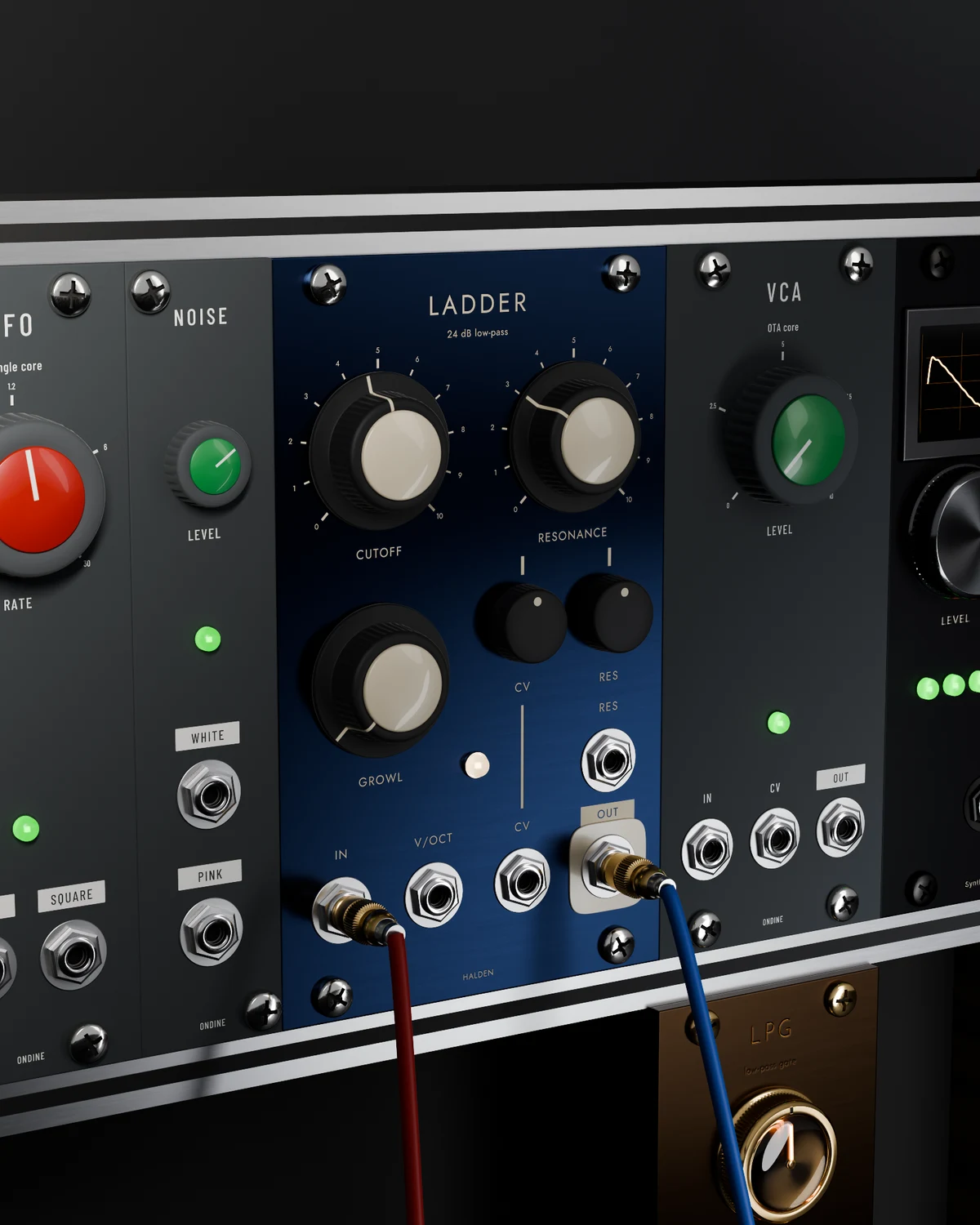
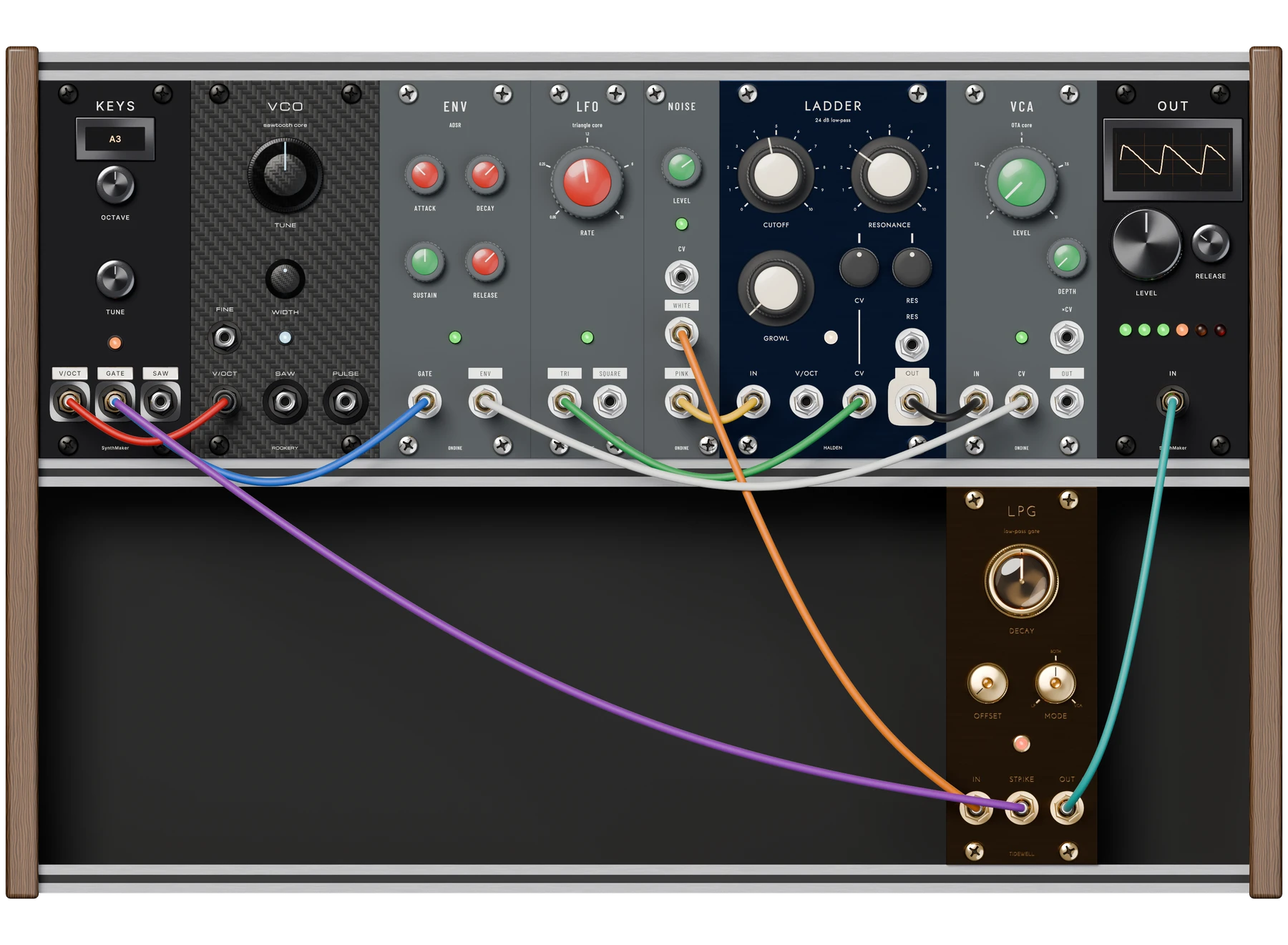
Follow along
Filament 1
This synth has no oscillator
Build Keys, a transistor ladder and Out in an empty case, then turn up the resonance until the filter sings the notes.
This lesson is in SynthMaker for Mac: Help › Lessons › Filament 1.
Build it in SynthMaker for MacFilament's makers are imaginary, except SynthMaker. Every circuit is real.