 SynthMaker
The optocoupler
An optocoupler is an LED and a light-dependent resistor sealed in one small package. Light the LED and the resistor drops; let it go dark and the resistor climbs back, slowly. That lag is the sound of an amp's opto tremolo and of an opto compressor.
New words
An optocoupler is an LED lighting a light-dependent resistor (O1 anode cathode a b): the LED's side and the resistor's side touch only by light.

A light-dependent resistor is a resistor whose value drops the brighter it is lit: megohms in the dark, down to about 10 Ω fully lit.

1Writing one
Write an optocoupler as O, then its LED's anode and cathode, then the two ends of its resistor:
O1 anode cathode a b [fast | slow]- The LED needs a resistor in line with it to limit its current, as on a board: write it as a part of its own.
- Only light links them: the LED's side and the resistor's side share no wire.
- The resistor drops quickly when lit and climbs back slowly. After 16 mA through the LED stops,
fast(used if you write neither) climbs back to 100 kΩ in 5 ms;slowtakes 80 ms. - After a long, bright spell it remembers: it takes seconds to climb all the way back into the megohms once the light goes off.
2A tremolo
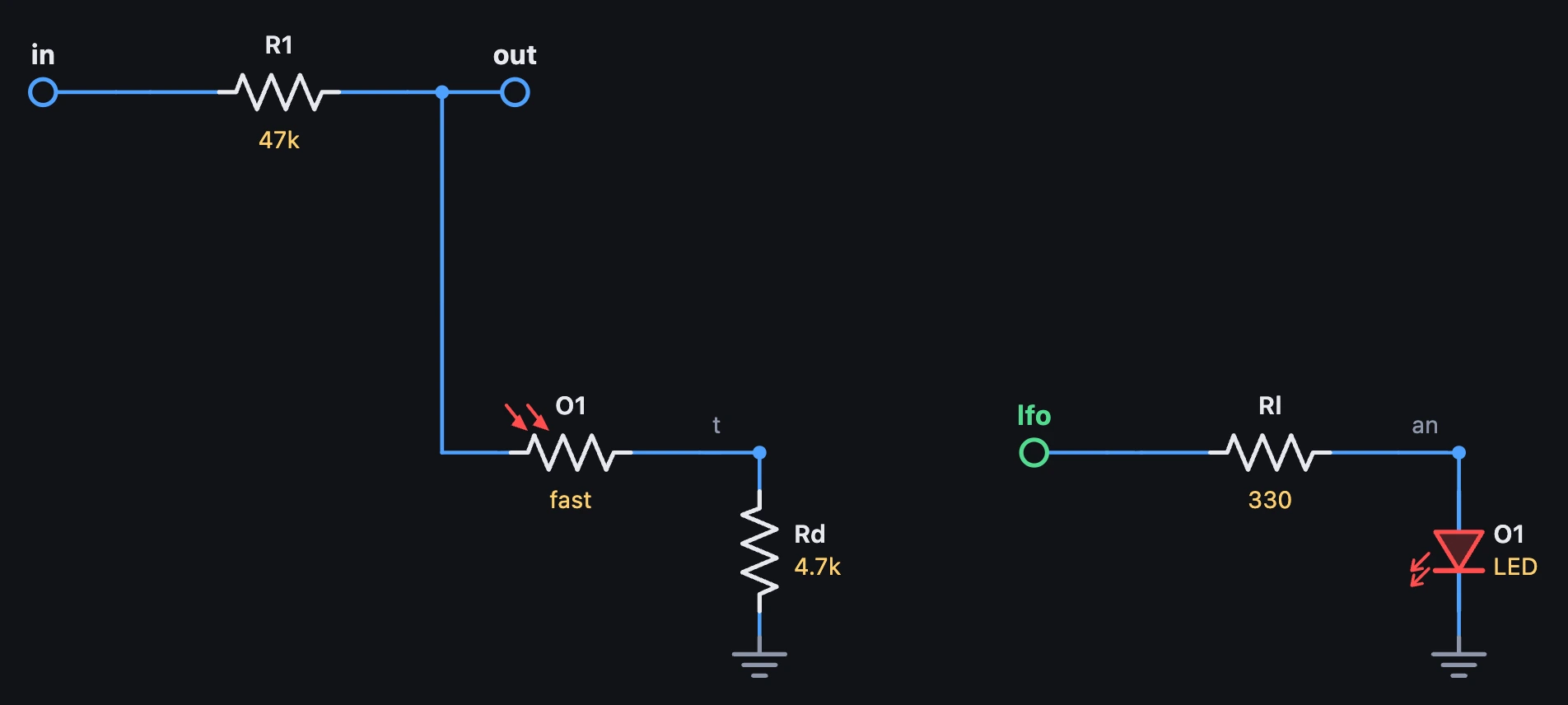
In Opto Tremolo, the LFO drives the LED through Rl: the higher it swings, the brighter the light. The resistor, between the sound's path and ground, through Rd, pulls the sound down as it lights. Because it drops fast when lit and climbs back slowly, the throb is rounder than a VCA's.
Change fast to slow and the throb gets shallower and rounder still. Feed the LED from the sound itself instead (through a detector, which turns the sound into a steady level, and some gain), and the louder the sound, the more the resistor pulls it down: a compressor.
# A tremolo. The LFO drives the LED through Rl: the higher it swings, the brighter the light. The light-dependent# resistor, between the sound's path and ground through Rd, pulls the sound down as it lights: a throb, rounder than a# VCA's. Change fast to slow for a softer, shallower one.circuit OptoTrem in lfo: from 5 V to 10 V Rl lfo an 330 O1 an gnd out t fast Rd t gnd 4.7k R1 in out 47kend3Its limits
- A circuit holds up to 4 optocouplers, and each one's LED counts as one of its diodes.
- One kind of resistor, at two speeds. Its LED is the red LED's model.
- It lights faster than the data sheets say: from dark to 63% of the way at 20 mA, 0.33 ms with
fastand 2 ms withslow, where the sheets say 5 ms. - No temperature effects, no limit on the voltage across the resistor, and no lamp in place of the LED.
Try it
- Open Opto Tremolo and hold a chord.
- In the parts list, change
fasttoslow: a gentler throb. - Turn the LFO's rate down to 2 Hz: a slow swell, with the lag easier to hear.
- Change
Rd t gnd 4.7kto22k: the resistor can pull the sound down less, so the tremolo is shallower.
Remember
- An optocoupler is
O1 anode cathode a b: an LED lighting a resistor between a and b. - It drops quickly when lit and climbs back slowly:
fast(the default) in 5 ms,slowin 80 ms. - An LFO on its LED is a tremolo; the sound itself on its LED is a compressor.