 SynthMaker
Noise sources
Real parts hiss. A noise source puts that hiss into a circuit as a part of its own, for wind, breath or hi-hats: a random current between two points, which the rest of the circuit filters, amplifies and shapes. Each voice has its own noise.
New words
A noise source is a random current from one point into another (N1 a b thermal 10k): hiss, as a part of the circuit.
White noise has the same strength at every frequency; pink noise falls 3 dB an octave, so it sounds darker and fuller.

1Writing one
Write a noise source as N, the two points it joins, and what kind of noise it makes:
N1 a b thermal 10k | avalanche | 1uA [pink] [level …]thermal 10kis a resistor that makes its own noise, as every real resistor does. It is a resistor too:N1 a gnd thermal 10kis a 10 kΩ resistor from a to ground, with its hiss. A 10 kΩ resistor's hiss is about 1.8 µV across the audible band, too quiet to hear without a level.avalancheis the classic noise source: a small transistor's junction pushed backwards until it breaks down. About 3 mV across the audible band, so real circuits follow it with a gain of 100 or so. Take it through a capacitor, as the real circuit does.- A current, such as
1uA, is a plain random current of that size, measured across the audible band. pinkturns it pink: 3 dB less each octave up, as strong as the white at 1 kHz. If you leave it out, it is white.level +40dBturns it up that many dB above the part's real amount. A level can be a setting in dB, a knob a wire can turn, and turning it adds no extra work.
An avalanche source, with its bias resistor, taken through a capacitor:
N1 j gnd avalanche
Rb j gnd 100k
C1 j b 100n2Wind from a resistor
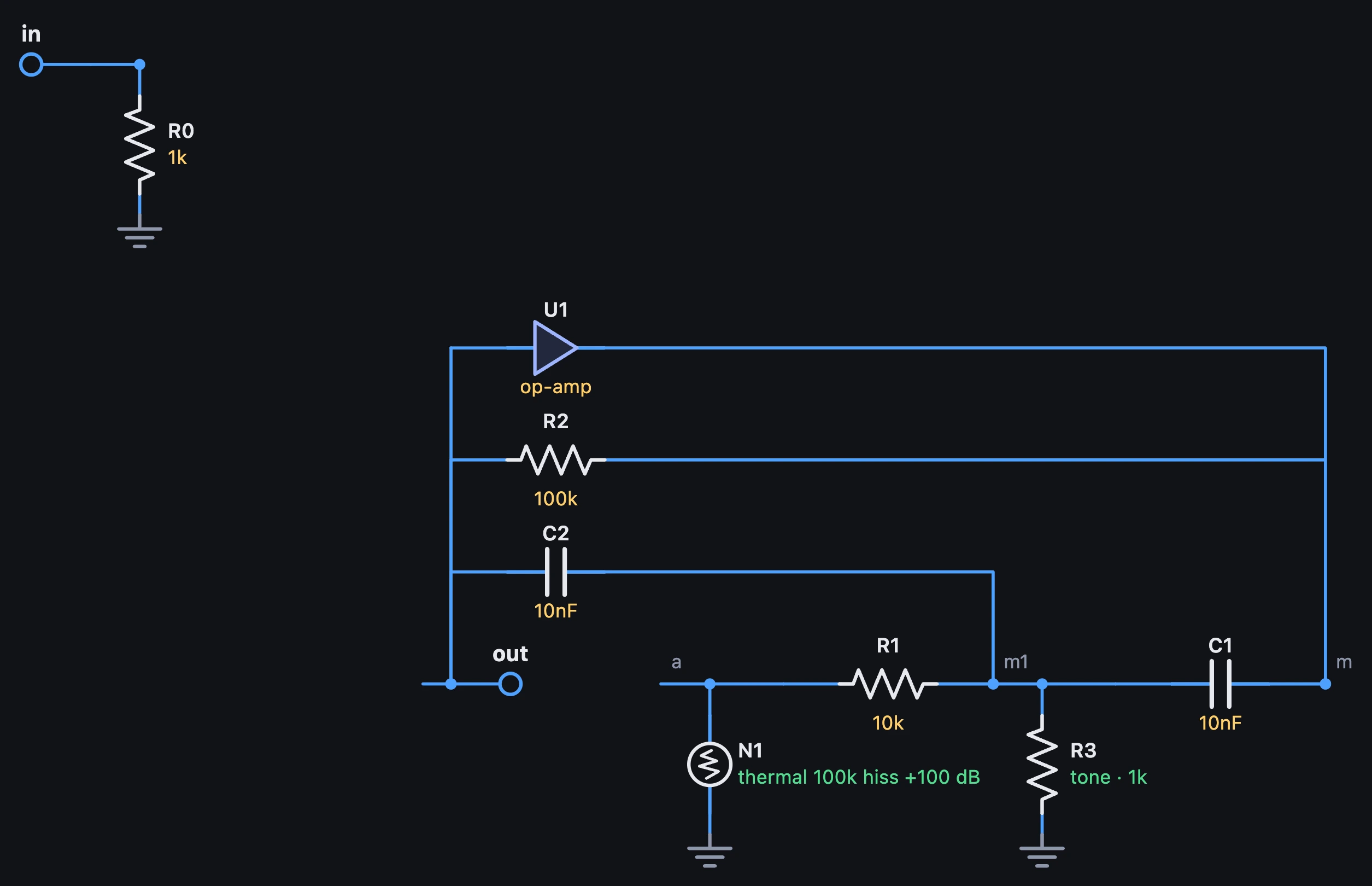
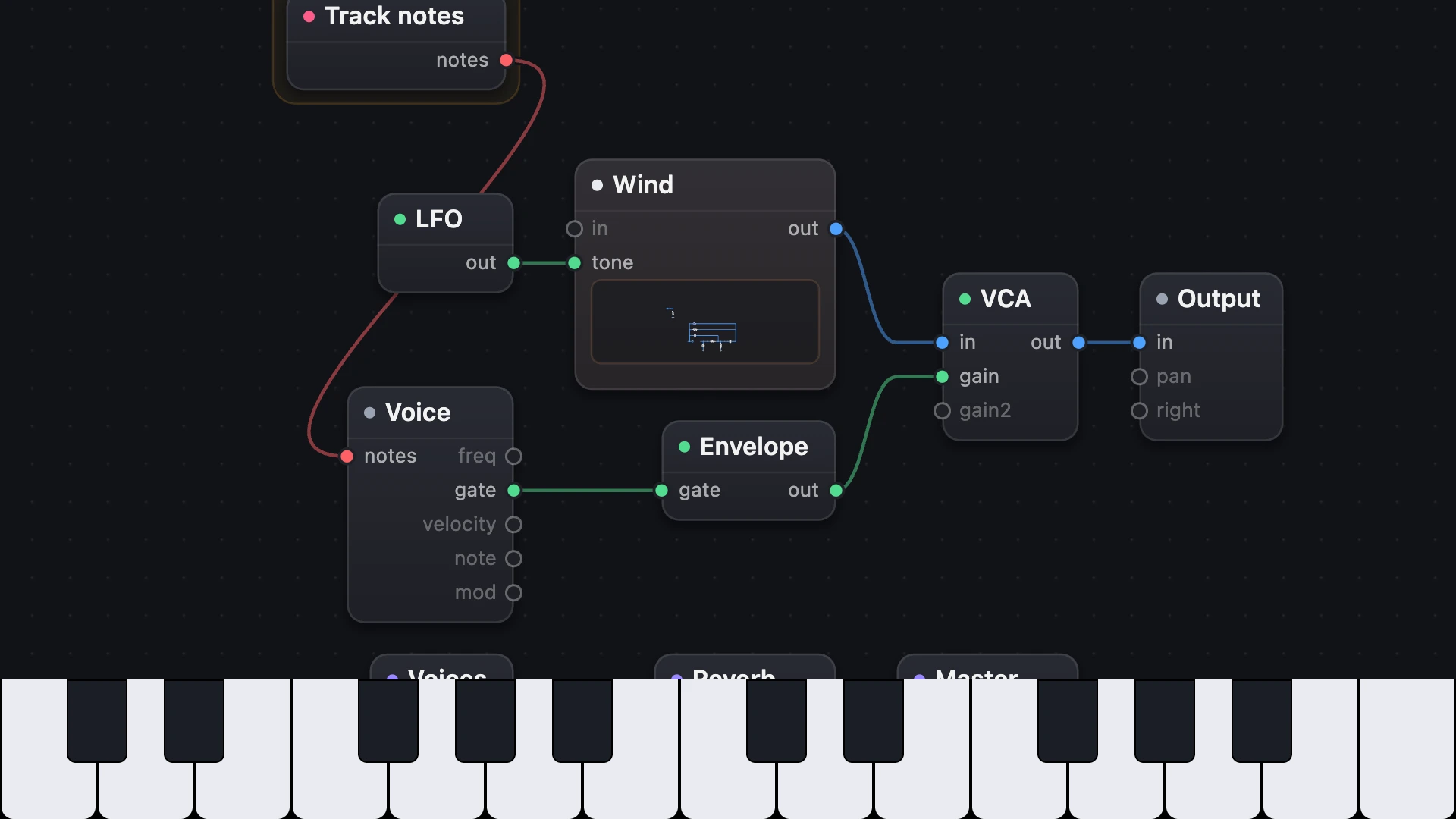
In Thermal Wind, N1 is a 100 kΩ resistor's own hiss, turned up 100 dB by hiss. A band-pass filter round the op-amp U1 keeps a narrow band of it, and an LFO turns the filter's tone resistor slowly up and down: wind.
Each voice has its own noise, so a chord is several gusts at once, each with its own hiss. A voice's noise also runs on from note to note, so each hit of a hi-hat made this way differs.
# A 100k resistor's own noise (N1, thermal), turned up by hiss, into a band-pass filter round U1. An LFO turns its tone# resistor slowly up and down: wind. Each voice has its own noise, so a chord is several gusts at once. R0 gives the# unused input, in, a way to ground.circuit Wind setting output: 0.25 V, from 0.025 V to 2.5 V setting tone: 1k, from 4.7k to 220 setting hiss: +100 dB, from 80 dB to 120 dB R0 in gnd 1k N1 a gnd thermal 100k level hiss R1 a m1 10k C1 m1 m 10n C2 m1 out 10n R2 out m 100k R3 m1 gnd tone U1 gnd m out opampend3Its limits
- A circuit holds up to 4 noise sources.
- There is noise only where a noise source is written: the other resistors, the transistors and the op-amps are quiet.
- There is no flicker noise (the kind that grows toward the bass):
pinkis the nearest. - The avalanche source is white, smooth and steady. A real one can also pop now and then at low currents.
Try it
- Open Thermal Wind and hold a chord.
- Turn
hissdown to 80 dB: the same wind, much quieter. At 0 dB it would be the resistor's real hiss, far too quiet to hear. - In the parts list, add
pinkafterthermal 100k: a darker, rounder wind. - Turn the LFO's rate up to 1 Hz: the gusts become a whoosh.
Remember
- A noise source is
N1 a band its kind:thermal 10k,avalancheor a current such as1uA. pinkmakes it pink;levelturns it up above the real amount.- Each voice has its own noise, and a render plays the same noise every time.