 SynthMaker
Coils and the wah
A coil is a part of its own in a circuit now. With a capacitor beside it, it rings at one frequency, and that ring is the voice of a wah pedal. This page builds one: two transistors, a 500 mH coil and a pedal you can rock with an LFO.
New words
A coil (an inductor) is wire wound round and round. It lets slow changes through and pushes back against fast ones: a capacitor's opposite.
A coil and a capacitor together resonate: they pass energy back and forth and ring at one frequency, f = 1 / (2π √(L C)).

1What a coil does
Current through a coil builds a magnetic field, and the field fights any change in the current. So a coil is a plain wire for steady current and for low notes, and a growing obstacle as the frequency rises. A capacitor is the other way round: it blocks steady current and lets high frequencies through.
Write a coil as L, the two points it joins and its value in henries:
L1 out l 500mHA setting can turn a coil too, in henries:
setting coil: 500mH, from 100mH to 2H
L1 out l coil- Values as a parts list writes them:
500mH,500m,1H,100 mH. A smallmis milli. - A circuit holds up to 4 coils. A coil adds no work for each sample beyond a capacitor's, so it costs what a filter does.
2A coil and a capacitor ring
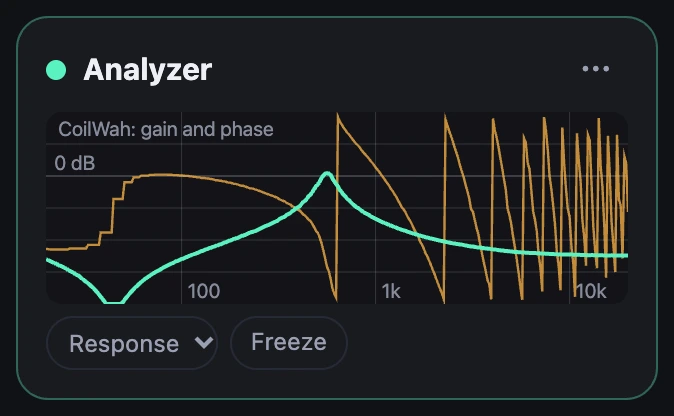
Put a coil and a capacitor side by side and they swap energy: the capacitor charges, the coil's current carries the charge back, and so on, at one frequency, f = 1 / (2π √(L C)). A sound fed in through a resistor comes out loudest at that frequency and quieter either side of it: a band-pass. The bigger the resistor, the narrower the band (its Q) and the longer it rings.
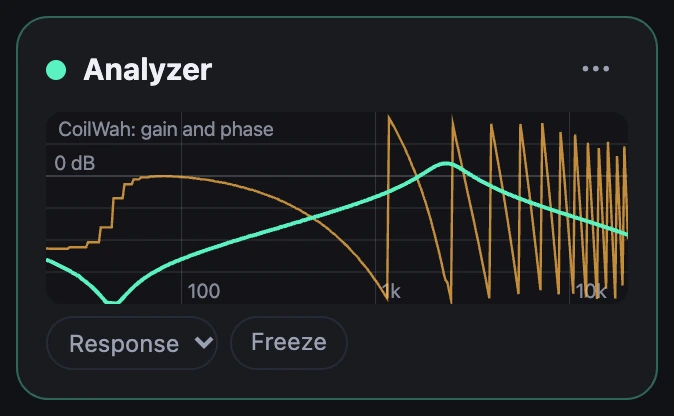
A 500 mH coil with 22 nF rings at 1.52 kHz. The pictures are an Analyzer's Response after the wah's circuit: the same peak, moved by the pedal.
3A wah round a coil
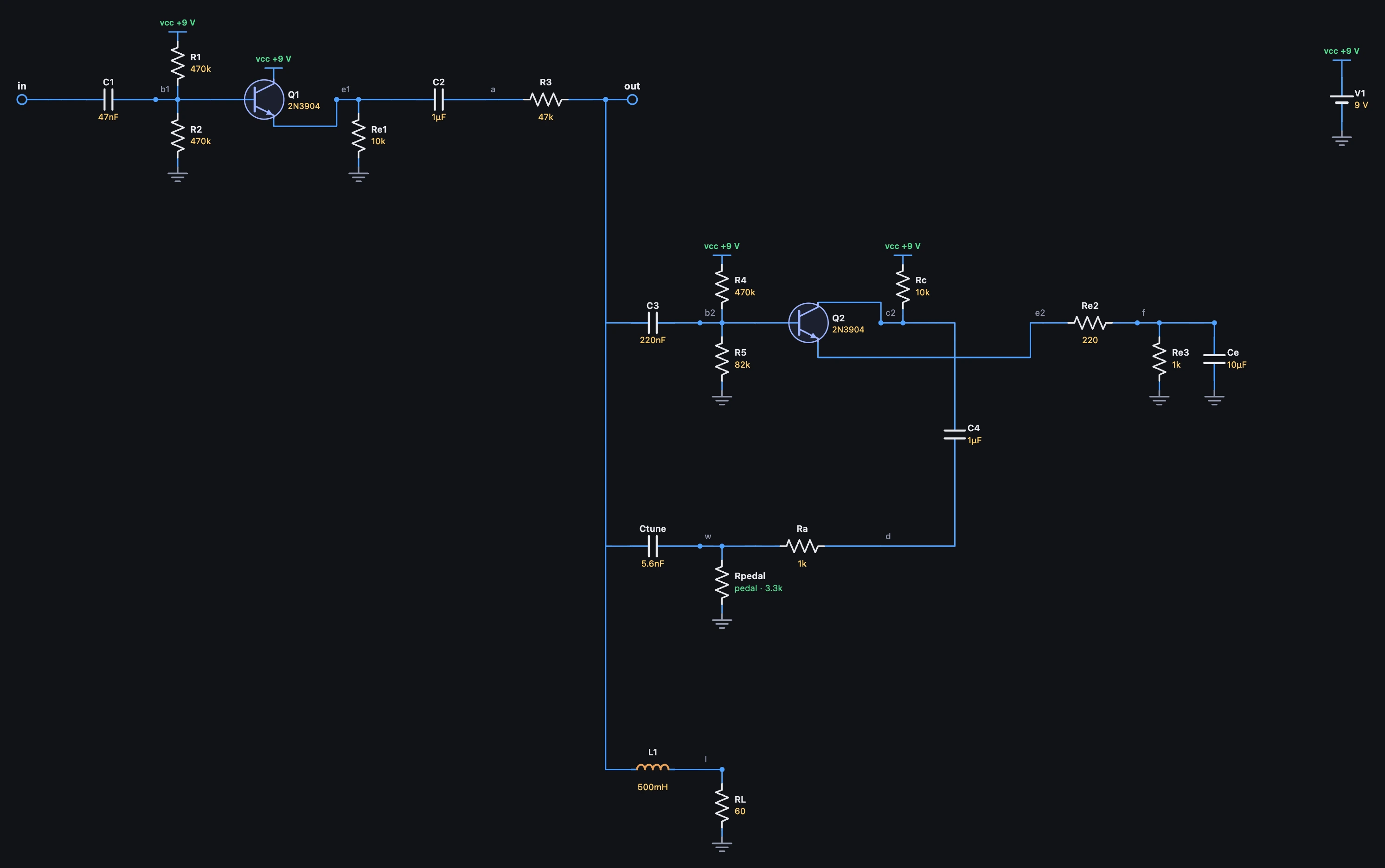
The classic wah pedals tune a coil this way, and Coil Wah does it from textbook parts:
- Q1 is a buffer: its emitter follows the sound, so what comes after it doesn't load what comes before.
- R3 feeds the coil L1 (with RL, its own 60 Ω of wire) and Ctune: the tuned circuit. Its top,
out, is what the module plays. - Q2 amplifies that point about 30 times, upside down. Through the pedal's pot (Ra and Rpedal) some of it comes back to Ctune's far end.
- The more comes back, the bigger Ctune looks to the coil, so the lower it rings.
pedalturns from 100k (the heel, about 530 Hz) down to 100R (the toe, about 2.6 kHz).
# A wah with a coil, as the classic pedals have one: a 500 mH coil (L1, with its own 60 ohm of wire) and Ctune make a# tuned circuit that rings at f = 1 / (2 pi sqrt(L C)). Q1 is a buffer for the sound; Q2 is a gain stage whose output# comes back to Ctune's far end through the pedal's pot (Ra and Rpedal). The more of it comes back, the bigger Ctune# looks to the coil, and the lower it rings: pedal turns from 100k (heel, about 530 Hz) down to 100R (toe, 2.6 kHz).# An LFO wired into pedal rocks it across the whole range once a beat, as a foot on the pedal would.circuit CoilWah setting input: 0.1 V, from 0.01 V to 1 V setting output: 0.02 V, from 0.005 V to 0.4 V setting pedal: 3.3k, from 100k to 100R V1 vcc gnd 9V C1 in b1 47n R1 vcc b1 470k R2 b1 gnd 470k Q1 vcc b1 e1 2N3904 Re1 e1 gnd 10k C2 e1 a 1u R3 a out 47k C3 out b2 220n R4 vcc b2 470k R5 b2 gnd 82k Q2 c2 b2 e2 2N3904 Rc vcc c2 10k Re2 e2 f 220 Re3 f gnd 1k Ce f gnd 10u C4 c2 d 1u Ra d w 1k Rpedal w gnd pedal Ctune out w 5.6n L1 out l 500mH RL l gnd 60end4Rocking the pedal
In Coil Wah an LFO is wired into pedal: at depth 1 it rocks the pedal across its whole travel, once a beat, as a foot would. Slow it to a bar for a lazy sweep, or set its shape to Square for a two-note wah.
In Envelope Wah an Envelope opens it on every note instead, the quack of an envelope filter on a bass. Its sine sub goes round the wah, so the low end stays.

- The wah: a circuit.
- Its pedal, wired.
- The LFO that rocks it.
Try it
- Open Coil Wah and play a few notes.
- In the parts list, change
Ctune out w 5.6nto10n: the whole sweep moves down. - Change
RL l gnd 60to300: the ring softens, a gentler wah. - Turn
inputup toward 1 V: the transistors start to bite.
Remember
- A coil is
L1 a b 500mH: a wire for steady current, an obstacle for high frequencies. - A coil and a capacitor ring at f = 1 / (2π √(L C)): a band-pass.
- A wah tunes that ring with a pot; wire an LFO or an Envelope into it to rock the pedal.