 SynthMaker
Parts you can turn
A setting line gives a circuit a knob that turns one of its parts, as a pot does. A wire can turn it too: an Envelope sweeping a filter's resistors on every note.
1A setting is a knob
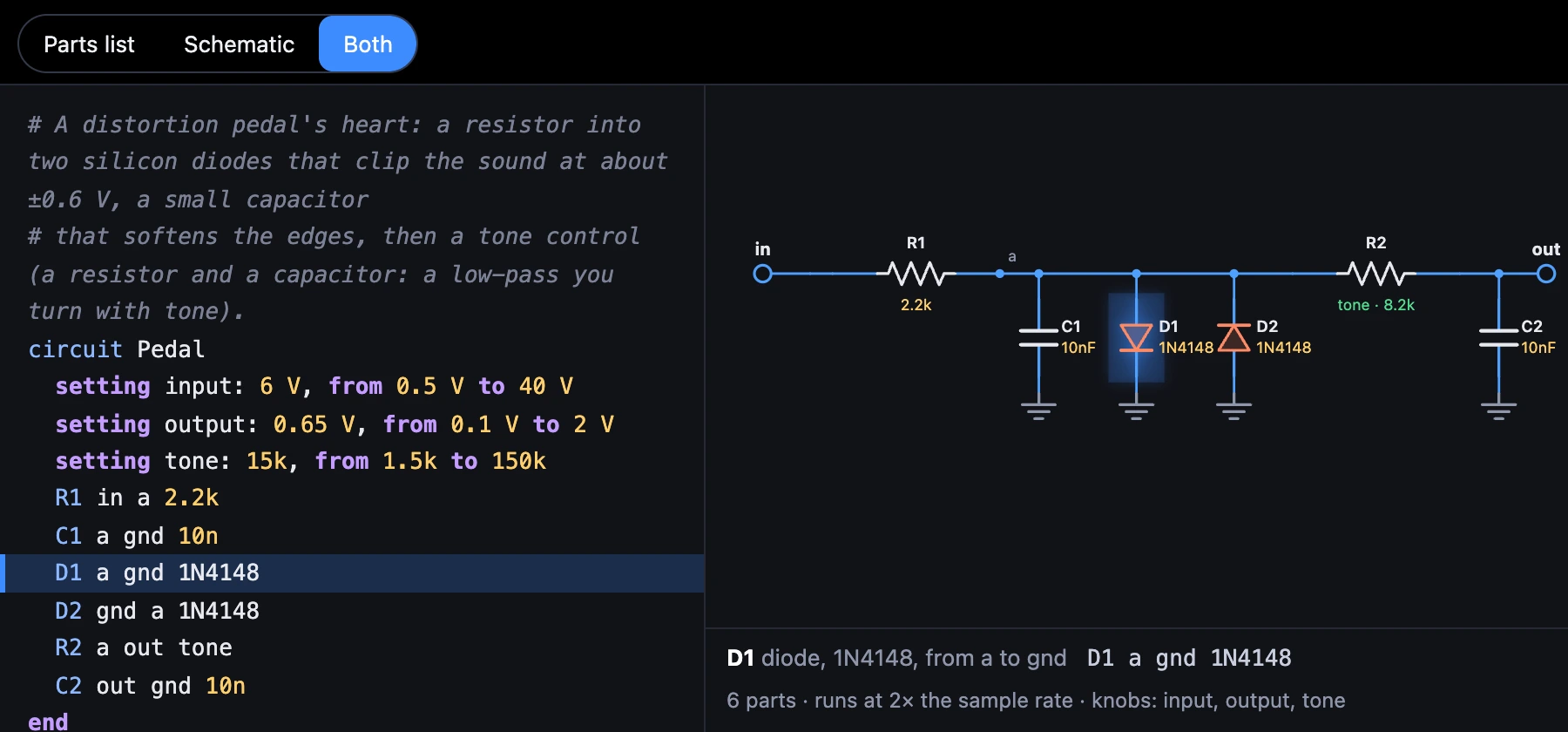
Write a setting's name where a part's value goes and the knob turns that part, in its own unit, ohms or farads:
setting tone: 15k, from 1.5k to 150k
R2 a out tone- The knob turns on a log taper, like a pot. Without a range it turns a decade either side of its value.
- A range written from the bigger value,
from 220k to 2.2k, is a pot wired the other way round: turning the knob up takes the resistance down. - One setting can turn several resistors together (a dual pot), or several capacitors, but not both.
2Wires into settings
Every setting is also an input of the circuit's box, under its own name. Wire an Envelope, an LFO or any control signal into it and the knob turns from where it's set: +1 is half the knob's travel up, −1 half down, held inside its range. Several wires into one setting add up.
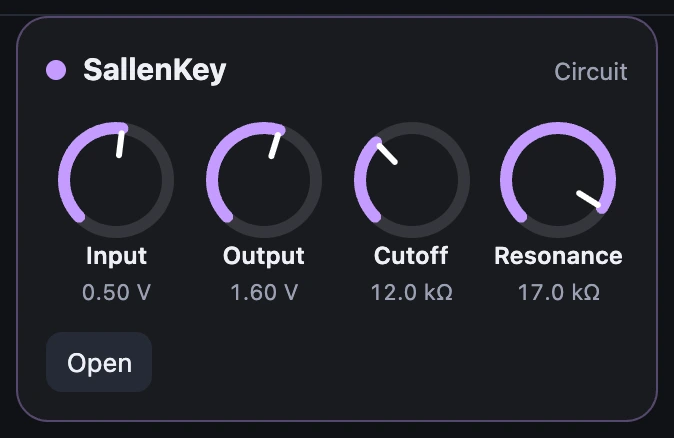
In Swept Sallen-Key an Envelope opens the cutoff on every note, then lets it fall back.

- The circuit.
- Its
cutoffsetting, as an input. - The Envelope that turns it.
3The ring on a wired knob
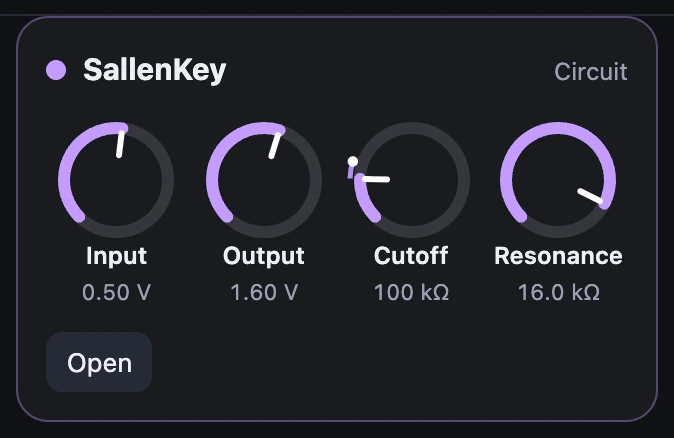
A wired knob shows a thin ring outside its own, from where it's set to where the wires have it now, and a dot there. In SynthMaker, play a note and watch it move.
4How fast it runs
A circuit runs at the sample rate when it's linear, and at twice it with a diode or an op-amp's rails, to keep the clipping clean. An oversample 2x line (or 1x, 4x) sets it yourself.
Try it
- Open Swept Sallen-Key and play low notes.
- Turn Cutoff up: the sweep starts higher.
- Turn Resonance up towards 19k: the filter rings at its cutoff.
Remember
setting name: value, from a to bmakes a knob; a part with that name as its value turns with it.- A wire into a setting turns it from where it's set: +1 is half the knob up.
- A wired knob shows a ring and a dot where the wires have it now.